
Biochemical and Physiological Behavior Against Salt Stress Effect on Two Quinoa Accessions (Chenopodium Quinoa Willd.)
Keywords:
Chenopodium Quinoa Willd, Salt Stress, Osmolytes, Photosynthetic Parameters, Total Grain YieldAbstract
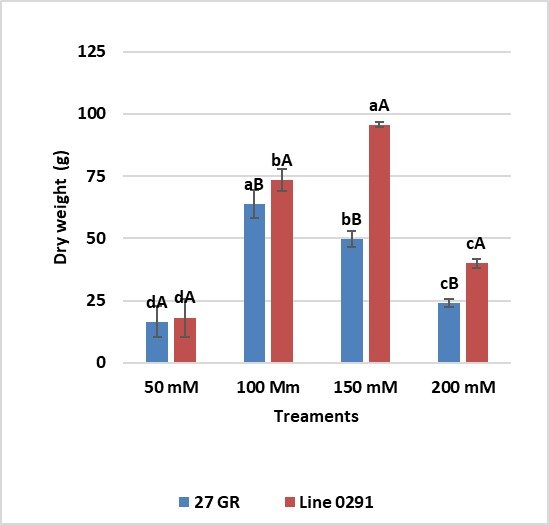
Chenopodium quinoa Willd., is a halophyte plant, showing a great variability of response to salt stress. To better understand quinoa response to salinity, an open field experiment was carried out by subjecting two different origins quinoa accessions (27 GR and Line 0291) irrigated with different NaCl concentrations (50, 100, 150 and 200 mM). Photosythetic parameters (stomatic conductance and photosynthetic activity) biochemical parameters (proline, total sugars, total proteins), dry matter, water content and total grain yield were determined at fruiting stage. Results showed that increasing NaCl concentration induce a stimulation of dry matter and water content of different accessions, which can be explained by a well osmotic adjustment. İn addition, in 150 and 200mM of NaCl, proline synthesis in leaves was stimulated of 50% and 54% for 27 GR and of 29% and 87% for Line 0291 respectively. Similary, sugar content seemed to be stimulated by increased NaCl concentrations. However, salt stress induces for total protein content, a stimulatory action for Line 0291 of 70.6%, 69.8% and 14.4%, but an inhibitory one for 27 GR of 15.54%, 35.65% and 51.79% respectively under 100, 150 and 200mM treatments. Correlation analysis showed that proline contents were positively and significantly (P0.05) correlated with water contents in accession 27 GR leaves (r=0.761). While in Line 0291 accession, water content was significantly correlated with protein content (r=0.893) and dry matter (r=0.768). A significant decrease was noted for photosynthetic parameters and total grain yield which the most affected accession was 27 GR. İn fact, Line 0291 accession has the highest ability to absorb more water under stress compared to the control, this is due to its capacity to accumulate more osmolytes in their cells. Therefore, it has a more important photosynthetic activity. This accession has also the highest dry matter production and total grain yield.
Downloads
References
S. Amini, H. Ghadiri, C. Chen and P. Marschner, “Salt-affected soils, reclamation, carbon dynamics, and biochar: a review”. J. Soils Sediments, 16, 939–953. 2016.
G. Abbas, M. Amjad, M. Saqib, B. Murtaza, ..., and G. Murtaza, “Soil sodicity is more detrimental than salinity for quinoa (Chenopodium quinoa Willd.): A multivariate comparison of physiological, biochemical and nutritional quality attributes”, Journal of Agronomy and Crop Science, 207, 59–73. 2021.
J. Lin, J.P.Li, F.Yuan, Z.Yang, B.S.Wang and Chen, M, “Transcriptome profiling of genes involved in photosynthesis in Elaeagnus angustifolia L. under salt stress”. Photosynthetica,56, 998–1009. 2018.
FAO (The Food and Agriculture Organization). Salt-Affected Soils. Food and Agricultural Organization, Rome, Italy. 2015.
S. Shabala, J. Bose and R. Hedrich, “Salt bladders: Do they matter?”. Trends Plant Sci, 19, 687–691. 2014.
Z. Yang, Y. Wang, X. Wei, X. Zhao, B. Wang and N. Sui, “Transcription profiles of genes related to hormonal regulations under salt stress in sweet sorghum”. Plant Mol. Biol. Rep, 35, 586–599. 2017.
D. Bazile, S.E. Jacobsen and A. Verniau, “The global expansion of quinoa: trends and limits”. Front. Plant Sci, 7, 622. 2016.
R. Choukr-Allah, N.K. Rao, A. Hirich, M. Shahid, ... and K.U.R. Butt, “Quinoa for marginal environments: toward future food and nutritional security in MENA and Central Asia regions”. Frontiers in Plant Science,7, 346. 2016.
A. J. Morales, P. Bajgain, Z. Garver, P. J. Maughan and J. A. Udall, “Physiological responses of Chenopodium quinoa to salt stress”. International Journal of Plant Physiology and Biochemistry, 3 (6):1–14. 2011. Vol : 02 , No. 04 , June-July 2022
A. Vega-Gálvez, M. Miranda, J. Vergara, E. Uribe, L. Puente, and E. A. Martínez, “Nutrition facts and functional potential of quinoa (Chenopodium quinoa willd.)”. Journal of the Science of Food and Agriculture 90 (15):2541–47. 2010.
C. Pulvento, M. Riccardi, A. Lavini, R. D. Andria, and R. Ragab, “Saltmed model to simulate yield and dry matter for quinoa crop and soil moisture content under different irrigation strategies in south Italy”. Irrigation and Drainage, 62:229–38. 2013.
C. Cocozza, C. Pulvento, A. Lavini, M. Riccardi, R. d’Andria, and R. Tognetti, “Effects of increasing salinity stress and decreasing water availability on ecophysiological traits of quinoa (Chenopodium quinoa Willd.) Grown in a mediterranean type agroecosystem”. Agro Crop Science, 199:229–40. 2013.
Y. Hu, H. Hackl and U. Schmidhalter, “Comparative performance of spectral and thermographic properties of plants and physiological traits for phenotyping salinity tolerance of wheat cultivars under simulated field conditions”. Functional Plant Biology, 44, 134–142. 2017.
E. Tavakkoli, F. Fatehi, S. Coventry, P. Rengasamy and G.K. McDonald, “Additive effects of Na+ and Cl− ions on barley growth under salinity stress”. J Exp Bot, 62: 2189–2203. 2010.
R. Schields and W. Burnett, “Determination of protein bound carbohydrate in serum by modifiedanthronemethod”. Analytical Chemistry, 32, 885-886. 1960.
P. Monneveux and M. Nemmar, « Contribution à l'étude de la résistance à la sécheresse chez le blé tendre (Triticum aestivum L.) et chez le blé dur (Triticum durum Desf.): Etude de l'accumulation de la proline au cours du cycle de développement ». Agronomie, 6, 583-590. 1986.
M. M. Bradford, “A rapid and sensitive method for the quantitation of microgram quantities of protein utilizing the principle of protein-dye binding.” Analytical biochemistry, 72.1-2:248-254. 1976.
J.R. Dinneny, “Traversing organizational scales in plant salt-stress responses”. Plant Biol, 23, 70–75. 2015.
V.I. Adolf, S. Shabala, M.N. Andersen, F. Razzaghi and S.E. Jacobsen, “Varietal differences of quinoa’s tolerance to saline conditions”. Plant Soil,357, 117–129. 2012.
V.I. Becker; J.W. Goessling; B. Duarte, ... and S.-E. Jacobsen, “Combined effects of soil salinity and high temperature on photosynthesis and growth of quinoa plants (Chenopodium quinoa)”. Funct. Plant Biol, 44, 665–678. 2017.
S. Eisa, S. Hussin, N. Geissler and H.W. Koyro, “Effect of NaCl salinity on water relations, photosynthesis and chemical composition of Quinoa (Chenopodium quinoa Willd.) as a potential cash crop halophyte”. Aust. J. Crop Sci, 6, 357–368. 2012.
R. Talebnejad and A.R. Sepaskhah, “Physiological characteristics, gas exchange, and plant ion relations of quinoa to different saline groundwater depths and water salinity. Arch. Agron. Soil Sci, 62, 1347–1367. 2016.
C. Zhi-Quan and Q. Gao, "Comparative physiological and biochemical mechanisms of salt tolerance in five contrasting highland quinoa cultivars." BMC plant biology 20.1: 1-2020. Vol : 02 , No. 04 , June-July 2022
H. Gheraibia, « Contribution à la Caractérisation des Paramètres Physiologiques, Biochimiques et Toxicologiques chez le blé dur (TriticumdurumDesf.) lors d'un Stress Oxydatif ». Thèse de doctorat. University Badji Mokhtar – Annaba. 2016.
A.A.M. Al-Mushhin, S.H. Qari, M.A. Fakhr, ..., M.H. Soliman, “Exogenous Myo-Inositol Alleviates Salt Stress by Enhancing Antioxidants and Membrane Stability via the Upregulation of Stress Responsive Genes in Chenopodium quinoa”. Plants, 10, 2416. 2021.
A.M.C. Ruffino, M. Rosa, M. Hilal, J.A. Gonzalez and F.E. Prado, “The role of cotyledon metabolism in the establishment of quinoa (Chenopodium quinoa) seedlings growing under salinity”. Plant and Soil, 326, 213–224. 2010.
S.E. Jacobsen, F. Liu, C.R. Jensen, “Does root-sourced ABA play a role for regulation of stomata under drought in quinoa (Chenopodium quinoa Willd.)”. Scientia Horticulturae, 122, 281–287. 2009.
S.E. Jacobsen, C. Monteros, L.J Corcuera, L.A Bravo, J.L Christiansen and A. Mujica, “Frost resistance mechanisms in quinoa (Chenopodium quinoa Willd.)”. European Journal of Agronomy, 26, 471–475. 2007.
A. Saddhe, Ankush, R.Manuka and S. Penna, "Plant sugars: Homeostasis and transport under abiotic stress in plants." Physiologia Plantarum, 171.4:739-755. 2021.
M. M. S. Abdallah, T. N. El Sebai, A. A. E. M. Ramadan, &H. M. S. El-Bassiouny, “Physiological and biochemical role of proline, trehalose, and compost on enhancing salinity tolerance of quinoa plant”. Bulletin of the National Research Centre, 44(1), 1-2020.
B. Lallouche, A. Boutekrabt, A. Hadjkouider, L. Riahi, S. Lamine and N. Zoghlami, « Use of physio-biochemical traits to evaluate the salt tolerance of five Opuntia species in the Algerian steppes”, Pakistan Journal of Botany, 49(3), 837-845. 2017.
B. Sarabi, S. Bolandnazar, N. Ghaderi and J. Ghashghaie, “Genotypic differences in physiological and biochemical responses to salinity stress in melon (Cucumis melo L.) plants: prospects for selection of salt tolerant landraces”. Plant Physiol Biochem. 119:294–311. 2017.
L. Yin, W. Shiwen, L. Jianye, T. Kiyoshi and O. Mariko, “Application of silicon improves salt tolerance through ameliorating osmotic and ionic stresses in the seedling of Sorghum bicolor”. Acta Physiol Plant, 35(11): 3099-3107. 2013.
Published
How to Cite
Issue
Section
Copyright (c) 2022 Authors

This work is licensed under a Creative Commons Attribution 4.0 International License.


