
Assessing user perspectives and debottlenecking of supply chain management for E-Aushadhi and FPLMIS in the Gaya district of Bihar- a cross-sectional study
Keywords:
Supply Chain, Dvdms, E-Aushadhi, Fplmis, Comprehensive Training., Supply Chain, DVDMS, E-Aushadhi, FPLMIS, Comprehensive Training.Abstract
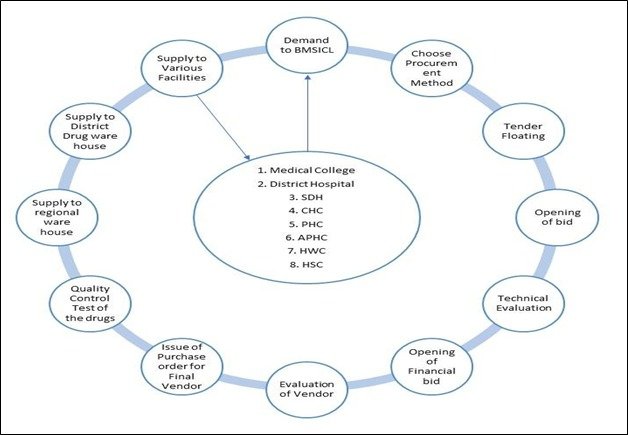
Background: The supply chain is the network or process through which goods, equipment, and commodities are delivered from the manufacturer to the end users, i.e., customers. In Bihar, all health-related commodities except vaccines & family planning commodities are procured by BMSICL i.e., Bihar Medical Services & Infrastructure Corporation Limited. The BMSICL procured medications and commodities using an open bidding mechanism on a quarterly basis. The Bihar government's LMIS system comprises DVDMS (E-Aushadhi) & FP-LMIS.
Objective: To assess & understand the Field Level Workers’ user perspectives on E-Aushadhi and FPLMIS and their challenges in the Gaya region of Bihar. Also, to understand & identify supply chain bottlenecks and potential alternatives.
Methods: It is a cross-sectional mixed method study conducted in the 7 randomly selected blocks in the Gaya district of Bihar. The sample size of the quantitative interview is calculated to be 100 and more over 8 In-Depth interviews with the Pharmacist at block and district level facilities and warehouse. The data analysis was done by the statistical software like SAS, Atlas.Ti and MS Excel.
Results: The utilization rate of the E-Aushadhi and FPLMIS was found to be 79% and 10% respectively among the ANMs. They encounter many challenges like lack of basic and comprehensive trainings, availability of transportation and dual system entry of the drugs. There are the various challenges faced by the pharmacist at facility level which include getting the late supply of the drugs, receiving counterfeit medicines, unavailability of storage units and many more.
Conclusion: The end users were satisfied with the introduction of this system but on the other hands they encounter various challenges in the same. To overcome these challenges, the government should focus on capacity building and maintaining system strictness along with the proper training and availability of the trained staff.
References
Bhardwaj, P., Joshi, N., Suthar, P., Jain, Y., Joshi, V., & Singh, K. (2021). Overview of e-Health initiatives in Rajasthan: An exploratory study. Journal of Family Medicine and Primary Care, 10(3), 1369. https://doi.org/10.4103/jfmpc.jfmpc_1989_20
Bhardwaj, P., Mantri, N., Joshi, N., Manda, B., Joshi, V., Singh, K., & Passi, R. (2022). Assessment of e-aushadhi program (drug inventory e-health initiative in Rajasthan) using benefit evaluation framework. Journal of Family Medicine and Primary Care, 11(5), 2038. https://doi.org/10.4103/jfmpc.jfmpc_2047_21
BMSICL. (2022). Welcome to BMSICL. Bmsicl.gov.in. http://bmsicl.gov.in/
DVDMS CENTRAL DASHBOARD. (2022). Central Dashboard. Cdashboard.dcservices.in. https://cdashboard.dcservices.in/CDDB/hissso/Login.cwh
FAMILY PLANNING DIVISION MINISTRY OF HEALTH & FAMILY WELFARE GOVT. OF INDIA. (2018). Medical, Health & Family Welfare Department, Government of Rajasthan. Rajswasthya.nic.in. https://rajswasthya.nic.in/FPLIMIS/FPLMIS%20User%20Guide.pdf
FP-LMIS, Ministry of Health and Family Welfare(Govt. of India). (2017, November). Loading... Fplmismohfw.in. https://fplmismohfw.in/IMCS/hissso/Login.fp
National Health Portal. (2021, June 21). Electronic Vaccine Intelligence Network(eVIN) | National Health Portal Of India. Www.nhp.gov.in. https://www.nhp.gov.in/electronic-vaccine-intelligence-network(evin)_pg
Pande, B., Mishra, S., & Dhanusu, S. (2022). A Study On Utility of Web-Based Drug Warehouse Management System (E-Aushadhi) In A Peripheral Hospital of Metropolitan City of Maharashtra. National Journal of Community Medicine, 13(12), 858–863. https://doi.org/10.55489/njcm.131220222478
Nigam, A., Aksin, O. Z., & Altug, M. (2019). Healthcare supply chain management: A comprehensive review. European Journal of Operational Research, 269(2), 401-420. doi: 10.1016/j.ejor.2018.01.009
Chandrasekharan, R., Sivabalan, M., Soundararajan, V., & Rajendran, C. (2015). Traditional practices in supply chain management in Indian public health sector. International Journal of Health Care Quality Assurance, 28(5), 477-485.
Prajapati, B., Thapa, R., & Shrestha, S. (2020). Traditional supply chain management practice and its effect on supply chain performance: a case study of Nepal. International Journal of Logistics Systems and Management, 35(4), 526-540.
Global Fund. (2017). Global Fund and India partnership strengthens HIV supply chain. Retrieved from https://www.theglobalfund.org/en/news/2017-10-04-global-fund-and- india-partnership-strengthens-hiv-supply-chain/
State Health Society Bihar. (2021). Supply Chain Management System. Retrieved from http://statehealthsocietybihar.org/SupplyChain.aspx
Singh, N., & Gupta, A. (2021). Supply chain management in healthcare: a case study of eVIN and E-Aushadhi in Bihar, India. Journal of Health Management, 23(1), 1-11.
Kumar, A., & Singh, A. (2018). E-Aushadhi: A digitalized drug supply chain management system. Journal of Medical Systems, 42(7), 122. doi: 10.1007/s10916-018-0997-6.
Johnson, R., et al. "Collaborative Partnerships for Medication Delivery: A Case Study of Local Pharmacies and Community Health Workers." Journal of Pharmaceutical Services.
Smith, M., & Brown, K. "Improving Medication Adherence through Collaborative Partnerships: The Role of Community Health Workers." Journal of Health Equity.
Published
How to Cite
Issue
Section
Copyright (c) 2023 Authors

This work is licensed under a Creative Commons Attribution 4.0 International License.


