A study to assess the effectiveness of information booklet on knowledge and attitude regarding weaning food among mothers in selected community area of Buldhana, Maharashtra, India
Keywords:
Malnutrition, Complementary Feeding, Weaning Practices, Maternal Knowledge, Infant Nutrition, Child Growth and Development.Abstract
Background: Malnutrition is a serious public health problem that causes child morbidity and mortality; India is ranked at 94th position in the list of 107 countries and has more than 33 lakh malnourished children in the country. The highest mortality observed is due to malnutrition and infection in children 0-4 years of age, with an estimated 21% of total deaths occurring in the 0-1 year age group. Weaning is a potent developmental event and is the transition period that occurs when breast milk alone is no longer enough after 6 months, leading to the introduction of complementary feeding.
Objective: To determine the knowledge and attitude of mothers regarding weaning practices.
Methods: An interventional study, with an evaluative design approach, was carried out on 60 mothers in Yelagon village of Buldhana district, Maharashtra in the months of August and September 2023 by purposive sampling technique. A 25 item pre and post test in the form of questionnaire was used to determine the knowledge of weaning, while a 10 statement questionnaire was used to determine the attitude. After collection of pre test data an information brochure about weaning was given to the participants.
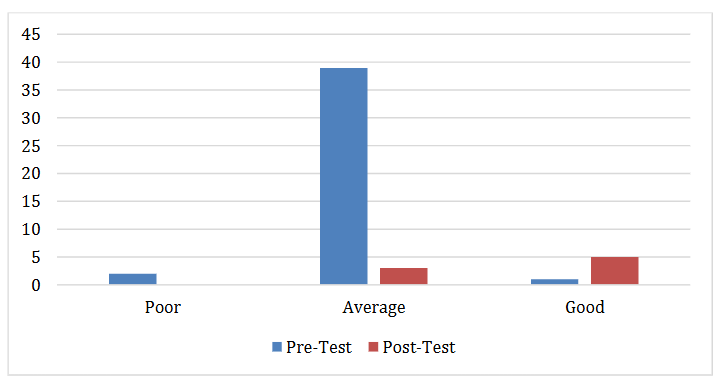
Results: At pre test, the proportion of mothers with poor knowledge score was 33.33%, average knowledge score was 65% while only 1.67% had good knowledge score with the mean knowledge score being 9.76 SD 2.95. The mean knowledge score showed an increase after the post test (19.06, SD 2.05).
Conclusion: There was a significant gap in knowledge about weaning before the intervention for mothers. An information booklet was distributed and considerable changes were seen in post-test knowledge as well as attitudes towards weaning practices, indicating that structured education interventions can be effective in this population.
Methods: This was a interventional study, used evaluative approach and conducted at Yelagon, Buldhana, Maharashtra amongst 60 mothers by purposive sampling method during the period of August to September 2023. pretest and post test knowledge on weaning was assessed through 25 questions and attitude was assessed by 10 statements. Information booklet was provided after pretest data collection.
Results: Majority of participants were in the age group of 23 to 27 years, out of 60 participants 39(65%) were from Hindu religion, 51.67% were belong to joint family. 42(70%) followed mixed (vegetarian and nonvegeterian ) pattern of food. Out of 60 mothers 33.33% of them had poor knowledge, 65% had average knowledge and only 1.67% of them had good knowledge. Average knowledge score at the time of pretest was 9.76with standard deviation of 2.95. Average post test knowledge score was 19.06 with standard deviation of 2.05, about attitude in pretest 1.67% of them had highly favorable and 38.33% of them had unfavorable attitude which was change in post test 31.67% of them had highly favorable, 68.33% had moderate favorable attitude and no one of them had unfavorable attitude. There is significant association found in knowledge and occupation and monthly income and between religion, types of family and attitude.
Conclusions: This study concluded that there was knowledge gap about weaning in mothers but after providing information booklet regarding weaning food there was significant improvement seen in post test knowledge level of mothers and attitude of them.
References
S. Akhtar, 'Malnutrition in South Asia-a critical reappraisal', Crit Rev Food Sci Nutr, vol. 56, no. 14, pp. 2320-2330, 2016. doi.org/10.1080/10408398.2013.832143
E. Kavosi, Z. H. Rostami, Z. Kavosi, A. Nasihatkon, M. Moghadami, and M. Heidari, 'Prevalence and determinants of under-nutrition among children under six: a cross-sectional survey in Fars province, Iran', Int J Health Policy Manag, vol. 3, no. 2, 2014. doi.org/10.15171/ijhpm.2014.63
Z. A. Bhutta, F. A. Bawany, A. Feroze, and A. Rizvi, The impact of the food and economic crisis on child health and nutrition. UNICEF conference. New York: UNICEF, 2008.
The World Bank. Prevalence of underweight, weight for age (% of children under 5) - South Asia. 2022.
T. Ahmed, M. Hossain, M. Mahfuz, N. Choudhury, M. M. Hossain, and N. Bhandari, 'Severe acute malnutrition in Asia', Food Nutr Bull, vol. 35, no. 2_suppl1, pp. S14-S26, 2014. doi.org/10.1177/15648265140352S103
H. Damodaran, 'Latest news today, breaking news, India news, top headlines', The Indian Express. [Online]. Available: https://indianexpress.com/. [Accessed: 29-Aug-2026].
Wizra Faiz et al' Knowledge and Practices of Infant and Toddler Weaning among Mothers 2, vol. 16. DOI, 2022. doi.org/10.53350/pjmhs2216642
W. Faiz, Z. Fayyaz, N. Mutai, and S. J. Bajwa, 'Knowledge and practices of infant and toddler weaning among mothers attending Pediatrics department of A tertiary care hospital in Lahore', Pakistan Journal of Medical and Health Sciences, vol. 16, no. 6, pp. 42-45, June 2022. doi.org/10.53350/pjmhs2216642.
D. Ambike, 'Astudy on the awareness ofthe weaning practices and the determinants affecting them in a rural hospital based pediatric outpatient clinic of Maval Taluka', MaharashtraInt J Contemp Pediatr, vol. 4, no. 1, pp. 206-209, Jan. 2017. doi.org/10.18203/2349-3291.ijcp20164605
L. Bisht and N. Suyal, 'Effectiveness of structure teaching programme on the level of knowledge regarding weaning among mother’s infants in a rural community area in Nainital', Int. J. Community Med. Public Health, vol. 9, no. 10, p. 3684, Sept. 2022. doi.org/10.18203/2394-6040.ijcmph20222556
R. Sharma, 'Knowledge and Attitude regarding Weaning among Mothers of Infants in selected areas of Gurugram', India International Journal of Research Publication and Reviews, vol. 3, pp. 2378-2383, Apr. 2022. doi.org/10.55248/gengpi.2022.3.4.18
Published
How to Cite
Issue
Section
Copyright (c) 2023 Prof. Rohini Bhaguji Pawar, Anurag Sarkate, Vrushali Dongardive

This work is licensed under a Creative Commons Attribution 4.0 International License.