
Problems in apple farming: a case of kashmir valley
Keywords:
Apple Farming, Problems in Apple Farming, Climate Change, Pesticide Selection, Pest Attacks, Market AccessAbstract
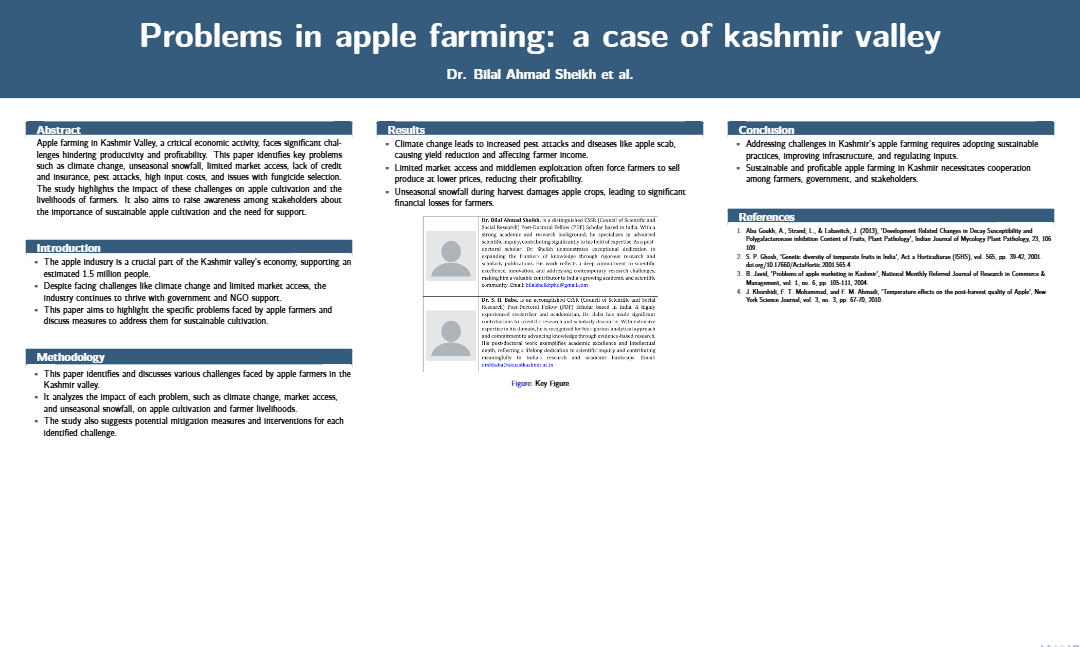
Apple farming is a critical economic activity in the Kashmir valley, providing livelihoods to thousands of farmers. However, apple farmers in the region face several challenges that hinder their productivity and profitability. These challenges include climate change, unseasonal snowfall, lack of credit and insurance, pest attacks, high input costs, market access, and the selection of proper fungicides. Climate change has caused a shift in the apple-growing regions and has led to increased pest attacks, while unseasonal snowfall damages the apple trees and reduces the yield. Lack of credit and insurance prevents farmers from investing in their farms, while high input costs and the selection of proper fungicides add to their production costs. Market access remains a significant challenge for farmers, with many of them having to sell their produce at lower prices due to a lack of proper market infrastructure. These challenges require immediate attention and support from the government and other stakeholders to ensure the sustainability of apple cultivation in the region and the livelihoods of the farmers. In this context, this paper aims to highlight the challenges faced by apple farmers in the Kashmir valley, their impact on apple cultivation, and the measures that can be taken to address these challenges. The paper also aims to create awareness among stakeholders regarding the importance of sustainable apple cultivation and the need to support apple farmers in the region.
Downloads
References
A. Abu Goukh, L. Strand, and J. Labavitch, 'Development-related changes in decay
susceptibility and polygalacturonase inhibitor content of fruits', Indian Journal of Mycology and Plant Pathology, vol. 23, pp. 106-109, 2013.
S. P. Ghosh, 'Genetic diversity of temperate fruits in India', Acta Horticulturae (ISHS), vol. 565, pp. 39-42, 2001. 10.17660/ActaHortic.2001.565.4
B. Javid, 'Problems of apple marketing in Kashmir', National Monthly Refereed Journal of Research in Commerce & Management, vol. 1, no. 6, pp. 105-111, 2004.
J. Khorshidi, F. T. Mohammad, and F. M. Ahmadi, 'Temperature effects on the post-harvest quality of apple', New York Science Journal, vol. 3, no. 3, pp. 67-70, 2010.
S. M. Mir, 'Problems of apple industry in J&K with special reference to Sopore town', International Journal in Management and Social Science, vol. 2, no. 3, pp. 33-46, 2014.
N. Ahmad, Problems and prospects of temperate fruits and nut production scenario in India vis-à-vis international scenario. Srinagar: Central Institute of Temperate Horticulture, 2013.
K. Weinberger and A. L. Thomas, 'Diversification into horticulture and poverty reduction: A research agenda', World Development, vol. 35, no. 8, pp. 1464-1480, 2007. 10.1016/j.worlddev.2007.05.002
F. Ellis, Rural Livelihoods and Diversity in Developing Countries. Oxford, U.K.: Oxford University Press, 2000.
R. K. Swarup and B. K. Sikka, Production and Marketing of Apples. Delhi: Mittal Publications, 1987.
Z. A. Malik and T. Choure, 'Horticulture growth trajectory: evidence in Jammu and Kashmir (A lesson for apple industry in India)', Journal of Business Management & Social Sciences Research, vol. 3, pp. 7-10, 2014.
J. Boyer and R. H. Liu, 'Apple phytochemicals and their health benefits', Nutrition Journal, vol. 3, no. 5, pp. 1-15, 2004. 10.1186/1475-2891-3-5
V. Jankuloska, I. Karov, and G. Pavlovska, 'Residue analysis of difenoconazole in apple fruits grown in Republic of Macedonia', Agricultural Science and Technology, vol. 10, no. 1, pp. 63-66, 2018. 10.15547/ast.2018.01.015
Published
How to Cite
Issue
Section
Copyright (c) 2023 Dr. Bilal Ahmad Sheikh, Dr. S. H. Baba

This work is licensed under a Creative Commons Attribution 4.0 International License.


