
Isolation and identification of wheat seed fungi and effect of microwave on fungi loads in salah al-din governorate in iraq
Keywords:
Wheat, Seeds, Fungi, Microwave, FungalAbstract
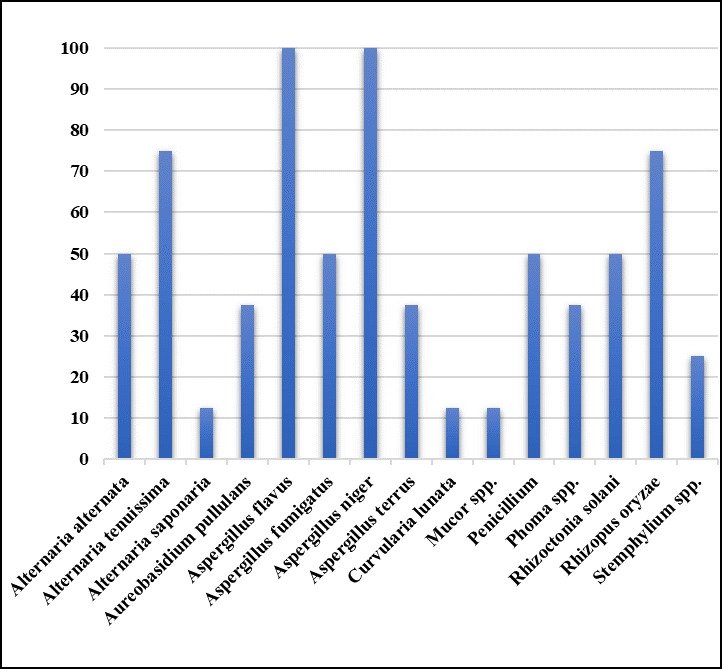
This study was conducted to determine the seed borne fungi of wheat cultivars in the seed production stores companies in Salah AL-Din Governorate, Iraq, 2021, and then evaluate the efficiency of Microwaves to kill or eliminate the fungal pathogens of wheat. The results of the study indicate that all samples of wheat seeds were contaminated with fungi in different percentage. 318 isolates of fungi were isolated from the studied wheat seed samples. They were identified culturally and microscopically according to approved taxonomic keys. The fungus A. flavus appeared with a percentage of 100 %, as it was present in all samples of the studied wheat seeds, as well as the species of A. niger. Then the species of Alternaria (A. alternata, A. tenuissima, A. saponaria) and the species of Aspergillus (A. flavus, A. fumigatus, A. terrus, A. niger), Rhizopus oryzae, Rhizoctonia solani, Penicillium spp, Aureobasidium pullulans, Phoma spp, Curvularia lunata, Stemphylium spp, and Mucor spp appeared with different percentages. an investigation into the effect of microwaves on fungal pathogens of wheat varieties was undertaken. This was achived by microwaving seeds at 0, 10, 20, 30 and 40 Seconds. Agar plate tests were used to ass’s pathogen loads. Pathogen levels were steadialy reduced at all treatment times and by 30 S treatment. All pathogens were consistently destroyed. In comparison, at 40 S the levels of saprophytic fungi were increased because it thermotolerant. The use of microwave radiation was a valuable tool for crop improvement, it was rapid, economic, efficient and safe to eradicating the pathogens.
Downloads
References
Satorre, E.H., Slafer, G.A., 1999. Wheat: Ecology and Physiology of Yield Determination. Food products press, An Imprint of The Haworth press, Inc G. G. Oliver, M. J. Knok, J. M. Mchugh, and N. D. Fountaine, 'Effects of microwaves on fungal pathogens of wheat seed', Crop protection, vol. 50, pp. 12-16, 2013. doi.org/10.1016/j.cropro.2013.03.009
R. A. Wesley, D. W. Lyons, T. H. Garner, and W. E. Garner, 'Some effect of microwave drying on cottonseed', Journal of Microwave power, vol. 94, pp. 329-340, 1974.
Pakhomov. A.G., Y. Akyel, O.N. Pakhomova, B.E. Stuck, M.R Murphy, 1998. Current State and implications of research on biological effects of millimeter. Bioelectromagnetics, 19 (7) : 393-413
Adhikari, B., Pangomm, K., Veerana, M., Mitra, S., & Park, G. (2020). Plant Disease Control by Non-Thermal Atmospheric-Pressure Plasma. Frontiers in Plant Science, 11(77). Doi: 10. 3389 /fpls. 2020.00077 doi.org/10.3389/fpls.2020.00077
Saeedeh Taheri / Development and evaluation of a non-chemical method with microwave source for disinfection of legumes / School of Agriculture and Food, Faculty of Veterinary and Agricultural sciences, The University of Melbourne / May 2020
P. R. Shewry, 'Wheat', J. Exp. Bot., vol. 60, no. 6, pp. 1537-1553, 2009. doi.org/10.1093/jxb/erp058
Soppe R, Saleh R. 2012. R. Report B2, 1 Historical Agricultural Production Data in Iraq. Iraq Salinity Project. The International Center for Agricultural Research in the Dry Areas (ICARDA), Beirut, Lebanon.
Senapati N and Semenov M a (2019) Assessing yield gap in high productive countries by designing wheat ideotypes. Scientific Reports 9 (1), 1-12.
Johansson E, Branlard G, Cuniberti M, Flagella Z, Husken A, Nurit E, Peña RJ, Sissons M, Vazquez D, 2020. Genotypic and environmental effects on wheat technological and nutritional quality. In: Wheat Quality For Improving Processing and Human Health. Springer, Cham. pp. 171-204
Cappelli, A.; Oliva, N. and Cini, E. (2020). Stone milling versus roller milling: A systematic review of the effects on wheat flour quality, dough rheology, and bread characteristics. Trends in Food Science and Technology, 97: 147-155
Chattha, S.H.; Hasfalina, C.M.; Mirani, B.N.; Mahadi, M.R. and Lee, T.S. (2016) . Food grain losses associated with indigenous storage methods and development of storage facilities for food security. International Food Research Journal V.
Chelladurai, D. Jayas, and N. White, 'Thermal imaging for detecting fungal infection in stored wheat', Journal of Stored Products Research, vol. 46, no. 3, pp. 174-179, 2010. doi.org/10.1016/j.jspr.2010.04.002
C. M. Christensen and H. Kaufmann, 'Deterioration of stored grains by fungi', Annual Review of Phytopathology, vol. 3, no. 1, pp. 69-84, 1965. doi.org/10.1146/annurev.py.03.090165.000441
Muir, W., & White, N. (2000). Microorganisms in stored grain. Manitoba:Grain Preservation Biosystems, 1-17.
Mathew, S. (2010). An evaluation on grain quality under post-harvest storage in selected indian wheat varieties. International Journal of Pharmaceutical Sciences and Research. 1(11): 174-177.
Ulziijargal, E.; Gorgo, Y.P. and Skorochod, I.O (2019). Detection of seedborne mycoflora in wheat. International Journal of Innovative Science and Research Technology, 4 (10): 532
S. Al-Rashdi, Biological control of root rot and wheat smut in soil not plowed. Iraq, 2011.
ISTA (2018). International Rules for Seed Testing Association, Vol. 2018, Full Issue i-19-8-(284).
A. S. Maryam, 'Isolation and Identification of Fungi from Cereal Grains in Libya', International Journal of Photochemistry and Photobiology, vol. 1, no. 1, pp. 9-12, 2017.
Fandohan P, B Gonovonfin B, Hell K, Marasas W F and Wing field M (2005) Natural occurrence of fusarium in stored maize in Benin West Africa. Int. J. Food Microbiol. 99, 173-183.
Al-Khalil, Abdullah bin Saleh bin Hassan (2011) the practical basis of fungi. Book. King Saud University. Riyadh. Third edition Ellis, M. B. (1971). Dematiaceous Hyphomycetes. Common wealth doi.org/10.1079/9780851986180.0000 Mycological institute, Kew, Surrey, England.
K. U. Domesch, W. Gams, and A. Traute-Heidi, 'Compendium of Soil Fungi', Compendium of Soil Fungi, vol. 1, 1980.
Nelson, P. E.; Toussoun, T. A. and Marasas, W. F. O. (1983). Fusarium species, an llustrated manual for identification, The Pennsylvania state university press, University park. 73:1457-146.
Pitt J I and Hocking a D (2007) Fungi and food spoilage. Academic Press, Sydney, Australia.
Mohammed Hamza Abass, Qusai Hattab Madhi and Abdulnabi Abdul Ameer Matrood.2021. Identity and prevalence of wheat damping-off fungal pathogens in different fields of Basrah and Maysan provinces. Bulletin of the National Research Centre.https://doi.org/10.1186/s42269-021-00506-0. doi.org/10.1186/s42269-021-00506-0
Duncan, D.B., 1995. Multiple range and Multiple F test. Journal of Biometrics. 11:1-42.
K. Mahmoud and A.-A. M. Khalfallah, Eds, Design and analysis of agricultural experiments. Dar Al-Kutub Foundation for Printing and Publishing. 2000.
A. R. Sarhan, 'Fungi associated with stored grains in the silos of Al-Qadisiyah Governorate', Al-Qadisiyah Journal, vol. 24, 1995.
A.-A. Saadoun, 'the use of alfalfa root powder and sodium hypochlorite as lternatives to the use of chemical pesticides to control fungus associated with wheat seeds before planting', Al-Qadisiyah Journal, 2005.
G. M. Christensen and L. C. Lopezf, 'Pathology of stored seeds', Proc. International seed testing association, vol. 28, pp. 701-711, 1963.
H. Dhakar and R. S. Ratnoo, 'Isolation of seed borne myco flora of wheat Triticum aestivum L. em. The ll. Seed samples', Journal of Pharmacognosy and Phytochemistry, vol. 7, no. 4, pp. 162-166, 2018.
Borrisova, L.; Tacheva, T. and Bajkushev, R. (2000). Amycotoxiclogical survey on wheat from two grain producing regions in Bulgaria, Vet. Med. 6: 29-31
B. Muhammad and Z. Hamid, 'Isolation and identification of fungi associated with wheat grains an Y. Ahmed and A. Hadeel, Isolation And Identification Of Fungi Carried In Wheat Seeds In Seed Production Companies In Nineveh Governorate, Iraq And The Study Of Varieties' Sensitivity To Some Fungi. 2021.
Y. Ahmed and A. Hadeel, Isolation And Identification Of Fungi Carried In Wheat Seeds In Seed Production Companies In Nineveh Governorate, Iraq And The Study Of Varieties' Sensitivity To Some Fungi. 2021.
Martinez Solis, J., Nieves Flores, A. and Pena Ortega M.G., (2014) "Physiological Seed Quality and Fungi Incidence in Wheat (Triticum aestivum L.) Seeds Treated with Microwave Radiation", Athens: ATINER'S Conference Paper Series, No: AGR2014-1234.
R. M. Daniel, M. Dines, and H. H. Petach, 'The denaturation and degradation of stable enzymes at high temperatures', Biochemistry Journal, vol. 317, pp. 1-11, 1996. doi.org/10.1042/bj3170001
Cavalante, M.J.B. and J.J. Muchovej. 1993. Microwave irradiation of seeds and selected fungal spores. Seed Sci. & Techn., 21: 247-253.
D. Ellis, S. Davis, H. Alexiou, and R. Handke, Robyn Bartley / Descriptions Of Medical Fungi / Mycology Unit Women's And Children's Hospital. .
Ferris, R. S. 1984. Effects of microwave oven treatment on microorganisms in soil. doi.org/10.1094/Phyto-74-121
Allison, D.Frisen (2014). Microwave Radiation as an Alternative control for seed-borne-Diseases in Dry Bean.
Brandt, k., Molgaard, J.P 2001.Organic agriculture does it enhance or reduce the nutritional value of plant foods? Journal of the Science of Food and Agriculture 81,924-931.
E. Barkat, Fungi Associated With Stored Wheat Grain in Australia: Isolation, Identification and. Alexandria, Egypt, 2016.
N. Shad, R. Ejaz, and A. Jamal, Iqra Haider Khan and Arshad Javaid .2019 Isolation and identification of seed associated fungi of. .
Thomas J. Walsh, Randall T. Hayden Davise H. Larone / Larone's. (2018). Medically Important Fungi / A Guide To Identification / 6TH Edition
Published
How to Cite
Issue
Section
Copyright (c) 2023 Maha Saud Khalaf, Hawazin Ahmed Abid, Rafea Zaidan Mukhlif Alsugmiany

This work is licensed under a Creative Commons Attribution 4.0 International License.


