Spatial distribution, habitat utilization, and seasonal population dynamics of mammalian fauna in agro forest ecotones of central India: a multi-year field assessment
Keywords:
Agro-Forest Ecotone, Camera Trapping, Population Dynamics, Habitat Suitability, Wildlife Corridor, MaxEnt ModellingAbstract
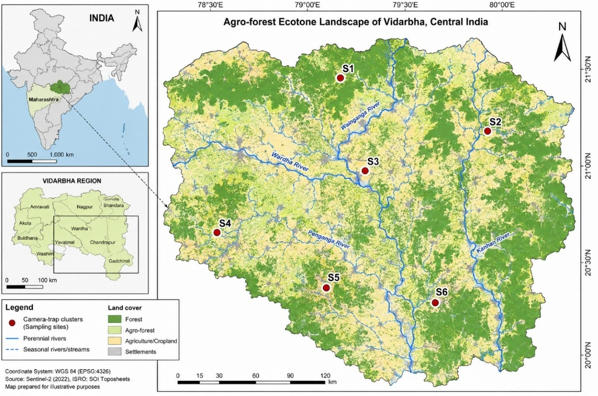
Agro-forest ecotones are a key transitional habitat in the Indian subcontinent with high mammal’s diversity, but poorly known in terms of species richness gradient and seasonal variation at the population level. In this study, a multi-year (2021-2024) comprehensive assessment of mammalian fauna was done in six study sites in agro-forest ecotones of the Vidarbha region of Central India that were stratified on the basis of habitat characteristics. We recorded 34 species, 8 orders, with the use of camera-trap grids (n = 144 stations), transect line sampling and acoustic monitoring. The Shannon Diversity Index (H') ranged from 2.14 to 3.67 at the sites, with forest dominated sites having significantly higher diversity (p < 0.001, ANOVA). Most activity occurred during the night or at dusk; the greatest activity was observed between 05:30-07:00 h and 18:00-20:00 h. Tree canopy density (>40% canopy), distance to water sources (<500 m), and proximity to crop fields were found to be the main habitat suitability modelling (MaxEnt) predictors of mammalian presence. Fluctuations between seasons were significant for four focal species (Indian leopard Panthera pardus fusca, striped hyena Hyaena hyaena, Indian crested porcupine Hystrix indica and golden jackal Canis aureus) and were related to the monsoon and agricultural cycles. The results of this study offer empirical reference points for wildlife corridors and human-wildlife conflict mitigation measures in one of the most ecologically-stressed areas in India.
Downloads
References
MacArthurR. H.WilsonE. O.The theory of island biogeographyPrinceton, NJPrinceton University Press200110.1515/9781400881376
KshettryA.VaidyanathanS.SukumarR.AthreyaV.Looking beyond protected areas: Identifying conservation compatible landscapes in agro-forest mosaics in north-eastern IndiaGlobal Ecology and Conservation22e00905202010.1016/j.gecco.2020.e00905
MajgaonkarI.PaulA.SharmaS.GhorpadeI.Mislabeled and misunderstood: Large mammal distribution underscores ecological significance of Agro-pastoral "wastelands" in India's Deccan PeninsulaEcology and Evolution161e72937202610.1002/ece3.72937
KorolY.Diversity and activity patterns of medium-sized and large terrestrial mammals in agroforests of a Peruvian Amazon Rainforest regionEcology and Evolution158e71997202510.1002/ece3.71997
ChakrabortyP.Camera trap-based monitoring of a key wildlife corridor reveals opportunities and challenges for large mammal conservation in Assam, IndiaTropical Ecology622186196202110.1007/s42965-020-00138-x
PhillipsS. J.AndersonR. P.DudikM.SchapireR. E.BlairM. E.Opening the black box: An open-source release of MaxentEcography407887893201710.1111/ecog.03049
ChaudharyV.Using population monitoring programs to detect changes in mammalian communitiesBiological Conservation276109778202210.1016/j.biocon.2022.109778
AhmedT.BargaliH. S.VermaN.KhanA.Mammals outside protected areas: Status and response to anthropogenic disturbance in western Terai-Arc landscapeProceedings of the Zoological Society742163170202110.1007/s12595-020-00360-4
AthreyaV.OddenM.LinnellJ. D. C.KrishnaswamyJ.KaranthK. U.Big cats in our backyards: Persistence of large carnivores in a human dominated landscape in IndiaPLOS ONE83201310.1371/journal.pone.0057872
BorahJ.Abundance and density estimates for common leopard Panthera pardus and clouded leopard Neofelis nebulosa in Manas National Park, Assam, IndiaOryx481149155201410.1017/S0030605312000373
RoveroF.MartinE.RosaM.AhumadaJ. A.SpitaleD.Estimating species richness and modelling habitat preferences of tropical forest mammals from camera trap dataPLOS ONE97e103300201410.1371/journal.pone.0103300
AhmadA.KanagarajR.GopiG. V.Wildlife habitat mapping using Sentinel-2 imagery of Mehao Wildlife Sanctuary, Arunachal Pradesh, IndiaHeliyon93202310.1016/j.heliyon.2023.e13799
KrishnakumarN.DivyaR.BoominathanD.SanketB.PranavC.RamakrishnanB.Population status and density estimate of Leopard Panthera pardus fusca in dry thorn forests of southern IndiaZoology and Ecology3314553202310.35513/21658005.2023.1.6
SinghP.GopalaswamyA. M.KaranthK. U.Factors influencing densities of striped hyenas (Hyaena hyaena) in arid regions of IndiaJournal of Mammalogy91511521159201010.1644/09-MAMM-A-159.1
NahaD.DashS. K.ChettriA.RoyA.SathyakumarS.Elephants in the neighborhood: Patterns of crop-raiding by Asian elephants within a fragmented landscape of Eastern IndiaPeerJ8202010.7717/peerj.9399
PandaD.MohantyS.BhandariA.High striped hyena density suggests coexistence with humans in an agricultural landscape, RajasthanPLOS ONE175e0266832202210.1371/journal.pone.0266832
VélezJ.An evaluation of platforms for processing camera-trap data using artificial intelligenceMethods in Ecology and Evolution142459477202310.1111/2041-210X.14044
ThomasL.Distance software: design and analysis of distance sampling surveys for estimating population sizeJournal of Applied Ecology471514201010.1111/j.1365-2664.2009.01737.x
DuttaT.SharmaS.MaldonadoJ. E.WoodT. C.PanwarH. S.SeidenstickerJ.Fine-scale population genetic structure in a wide-ranging carnivore, the leopard (Panthera pardus fusca) in central IndiaDiversity and Distributions197760771201310.1111/ddi.12024
KumbhojkarS.YosefR.MehtaA.BhattA.KumbhojkarS.Dependence of the leopard Panthera pardus fusca in Jaipur, India, on domestic animalsOryx555692698202110.1017/S0030605319001145
NorouzzadehS.Automatically identifying, counting, and describing wild animals in camera-trap images with deep learningProceedings of the National Academy of Sciences11525E5716E5725201810.1073/pnas.1719367115
DurbinJ.WatsonG. S.Testing for serial correlation in least squares regression, IBiometrika373-4409428195010.1093/biomet/37.3-4.409
OjhaA. P.SharmaG.RajpurohitL. S.Ecology and conservation of golden jackal (Canis aureus) in Jodhpur, RajasthanJournal of Applied and Natural Science9424912495201710.31018/jans.v9i4.1559
AhumadaA.Wildlife Insights: A platform to maximize the potential of camera trap and other passive sensor wildlife data for the planetEnvironmental Conservation47116202010.1017/S0376892919000298
MacArthurR. H.WilsonE. O.An equilibrium theory of insular zoogeographyEvolution174373387196310.1111/j.1558-5646.1963.tb03295.x
Published
How to Cite
Issue
Section
Copyright (c) 2026 Mrs. Kamleshwari Durgam

This work is licensed under a Creative Commons Attribution 4.0 International License.