Diversity, abundance, and habitat suitability of small carnivores and mesopredators in the agro-pastoral landscapes of Yavatmal district, Maharashtra, India: implications for conservation planning
Keywords:
Camera Trapping, Mesopredator Release, Occupancy Modelling, Maxent, Diel Activity, Agro-Pastoral MosaicAbstract
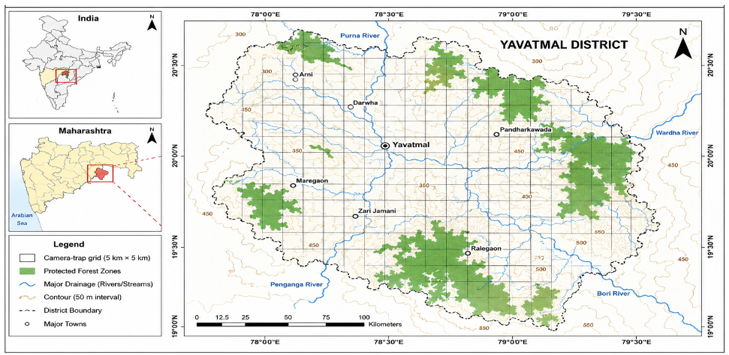
Small carnivores and mesopredators play an essential role in the functioning of terrestrial ecosystems, but are poorly studied in highly fragmented agro-pastoral landscapes with accelerated land-use change. In this study, mesopredator communities in Yavatmal District (Mumbai Division), Maharashtra were studied over a 2-year period from June 2022 to May 2024, comprising 96 camera trap stations and 8640 trap days. Five focal species were assessed: Bengal fox (Vulpes bengalensis), striped hyena (Hyaena hyaena), jungle cat (Felis chaus), small Indian mongoose (Herpestes edwardsii) and Indian hare (Lepus nigricollis). In total, 2,847 independent detections were made. The occupancy rates were 0.41 ± 0.06 for striped hyena and 0.78 ± 0.04 for small Indian mongoose. Habitat suitability modelling showed that the best predictive model was for the Bengal fox (AUC = 0.887), with particular emphasis on the importance of agricultural margins and ecotonal habitats. Activity analysis revealed that for all species, the dominant activity phase was crepuscular or nocturnal, and that there was significant temporal partitioning between the carnivore species (Δ = 0.31, p < 0.001). Species diversity, represented by the Shannon diversity index, was relatively high, and decreased significantly with distance from protected forest edges (r² = 0.61, p < 0.01) on a mean basis across sampling grids. The results would prove that the agro-pastoral landscapes of Yavatmal have a favourable mesopredator complex. It is important to enhance landscape connectivity and minimise retaliatory persecution and promote wildlife-friendly agriculture to help conserve these species. This study is the first spatially explicit baseline study of mesopredator ecology in Vidarbha and it gives important guidelines to conservation planning and sustainable land-use management.
Downloads
References
SchmitzO. J.KrivanV.OvadiaO.Predators and their prey: Foraging ecology as a source of ecological informationEcology Letters78733745200410.1111/j.1461-0248.2003.00560.x
RatnayekeS.van ManenF. T.PadmalalU. K. G. K.Home ranges and habitat use of sloth bears in Wasgomuwa National Park, Sri LankaUrsus1816778200710.2192/1537-6176(2007)18[189:LCOSBR]2.0.CO;2
De Souza Ferreira NetoG.OrtegaJ. C. G.Melo CarneiroF.Souza de Oliveira JrS.OliveiraR.Beggiato BaccaroF.Productivity correlates positively with mammalian diversity independently of the species' feeding guild, body mass, or the vertical strata explored by the speciesMammal Review523377391202210.1111/mam.12282
WearnO. R.RowcliffeJ. M.CarboneC.BernardH.EwersR. M.Assessing the status of wild felids in a highly-disturbed commercial forest reserve in Borneo and the implications for camera trap survey designPLoS One811e77598201310.1371/journal.pone.0077598
YemshanovD.Prioritizing restoration of fragmented landscapes for wildlife conservation: A graph-theoretic approachBiological Conservation232173186201910.1016/j.biocon.2019.02.003
CrooksK. R.SouléM. E.Mesopredator release and avifaunal extinctions in a fragmented systemNature4006744563566199910.1038/23028
PrughL. R.StonerK. E.EppsC. W.The rise of the mesopredatorBioScience599779791200910.1525/bio.2009.59.9.9
ElithJ.PhillipsS. J.HastieT.DudíkM.CheeY. E.YatesC. J.A statistical explanation of MaxEnt for ecologistsDiversity and Distributions1714357201110.1111/j.1472-4642.2010.00725.x
MacKenzieD. I.NicholsJ. D.LachmanG. B.DroegeS.RoyleJ. A.LangtimmC. A.Estimating site occupancy rates when detection probabilities are less than oneEcology83822482255200210.1890/0012-9658(2002)083[2248:ESORWD]2.0.CO;2
MacKenzieD. I.NicholsJ. D.RoyleJ. A.PollockK. H.BaileyL. L.HinesJ. E.Occupancy Estimation and Modeling: Inferring Patterns and Dynamics of Species OccurrenceBurlington, MA, USAAcademic Press201810.1016/B978-0-12-407197-1.00019-3
PhillipsS. J.AndersonR. P.DudíkM.SchapireR. E.BlairM. E.Opening the black box: An open-source release of MaxEntEcography407887893201710.1111/ecog.03049
ValaviR.ElithJ.Lahoz-MonfortJ. J.Guillera-ArroitaG.blockCV: An R package for generating spatially or environmentally separated folds for k-fold cross-validation of species distribution modelsMethods in Ecology and Evolution102225232201910.1111/2041-210X.13107
DickmanA. J.Complexities of conflict: the importance of considering social factors for effectively resolving human-wildlife conflictAnimal Conservation135458466201010.1111/j.1469-1795.2010.00368.x
ShiT.Beta 2-Glycoprotein I binds factor XI and inhibits its activation by thrombin and factor XIIa: loss of inhibition by clipped beta 2-glycoprotein IProceedings of the National Academy of Sciences of the USA1011139393944200410.1073/pnas.0400281101
PfeiferM.Creation of forest edges has a global impact on forest vertebratesNature5517679187191201710.1038/nature24457
SchoenerT. W.Resource partitioning in ecological communitiesScience18541452739197410.1126/science.185.4145.27
GaynorK. M.HojnowskiC. E.CarterN. H.BrasharesJ. S.The influence of human disturbance on wildlife nocturnalityScience360639412321235201810.1126/science.aar7121
ElithJ.GrahamC. H.AndersonR. P.Novel methods improve prediction of species distributions from occurrence dataEcography292129151200610.1111/j.2006.0906-7590.04596.x
DickmanA. J.MacdonaldE. A.MacdonaldD. W.A review of financial instruments to pay for predator conservation and encourage human-carnivore coexistenceProceedings of the National Academy of Sciences of the USA108341393713944201110.1073/pnas.1012972108
ChellamR.JohnsinghA. J. T.Management of Asiatic lions in the Gir Forest, IndiaSymposia of the Zoological Society of London65409424199310.1093/oso/9780198540670.003.0021
WilmersC. C.NickelB.BryceC. M.SmithJ. A.WheatR. E.YovovichV.The golden age of bio-logging: how animal-borne sensors are advancing the frontiers of ecologyEcology96717411753201510.1890/14-1401.1
ToblerM. W.Carrillo-PercasteguiS. E.PitmanR.MaresR.PowellG.An evaluation of camera traps for inventorying large- and medium-sized terrestrial rainforest mammalsAnimal Conservation113169178200810.1111/j.1469-1795.2008.00169.x
TrathanP. N.FretwellP. T.StonehouseB.First recorded loss of an emperor penguin colony in the recent period of Antarctic regional warming: implications for other coloniesPLoS One62e14738201110.1371/journal.pone.0014738
Aiello-LammensM. E.BoriaR. A.RadosavljevicA.VilelaB.AndersonR. P.spThin: an R package for spatial thinning of species occurrence records for use in ecological niche modelsEcography385541545201510.1111/ecog.01132
PandaD.MohantyS.SuryanT.PandeyP.LeeH.SinghR.High striped hyena density suggests coexistence with humans in an agricultural landscape, RajasthanPLoS One175e0266832202210.1371/journal.pone.0266832
GyhrsC.High level of daily heterothermy in desert gerbilsJournal of Tropical Ecology386451453202210.1017/S0266467422000360
GhatolS. G.KaraleR. L.Assessment of degraded lands of Vidarbha Region using remotely sensed dataJournal of the Indian Society of Remote Sensing282-3213219200010.1007/BF02989905
SunquistM. E.SunquistF.Wild Cats of the WorldChicago, USAUniversity of Chicago Press200210.7208/chicago/9780226518237.001.0001
SchwartzA. L. W.ShillingF. M.PerkinsS. E.The value of monitoring wildlife roadkillEuropean Journal of Wildlife Research661202010.1007/s10344-019-1357-4
Published
How to Cite
Issue
Section
Copyright (c) 2026 Mr. Devendra Kumar Durgam

This work is licensed under a Creative Commons Attribution 4.0 International License.