Community ecology, habitat suitability, and multi-threat assessment of mesopredator assemblages in agro-pastoral landscapes of central India: a camera-trap and MaxEnt approach
Keywords:
Camera Trapping, Mesopredator Release, Occupancy Modelling, Maxent, Temporal Partitioning, Central IndiaAbstract
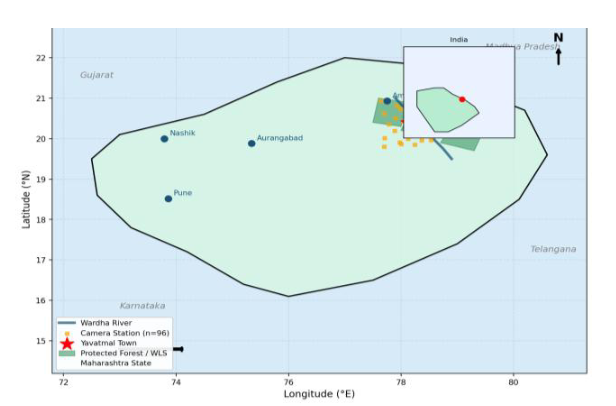
Background: Mesopredators and small carnivores undertake essential ecological roles in the tropics and their community-level dynamics in the agro-pastoral mosaics of central India have been poorly described. These ecologically important sets are under threat due to a combination of progressive loss and degradation of native vegetation, increasing livestock grazing and agricultural development in Vidarbha. Methods: The systematic camera trapping was carried out in 48 grid cells (5 km × 5 km) with 96 camera stations in Yavatmal District, Maharashtra state for the duration of June 2022 to May 2024 with 8,640 trap-nights. Five focal species (Bengal fox Vulpes bengalensis, striated hyena Hyaena hyaena, jungle cat Felis chaus, small Indian mongoose Herpestes edwardsii and Indian hare Lepus nigricollis) were used to construct single-season occupancy models (MacKenzie et al. framework), MaxEnt habitat suitability models, kernel-density diel activity estimation, and multi-threat index scoring. Results: 2,847 independent records were made. Occupancy estimates were corrected for values between 0.41 ± 0.06 (H. hyaena) and 0.78 ± 0.04 (H. edwardsii) and were significantly higher than naive estimates. Forest-agricultural ecotones had the largest AUC (0.887) value for habitat suitability for Bengal fox. There was a significant temporal partitioning between V. bengalensis and H. hyaena (Δτ = 0.31, p < 0.001). The Shannon diversity index averaged across cells was H' = 2.03, and significantly decreased with increasing distance from forest edges (r2 = 0.61; p < 0.001). Multi-threat analysis identified H. hyaena as being at the highest conservation priority. Discussion: Agro-pastoral landscape of Yavatmal has a functional significant mesopredator guild, even as the land-use change is in progress. There is a great need for evidence-informed interventions to support corridors, anti-persecution outreach, and mitigate road deaths.
Downloads
References
SollmannR.MohamedA.SamejimaH.WiltingA.Risky business or simple solution—Relative abundance indices from camera-trappingBiological Conservation159405412201310.1016/j.biocon.2012.12.025
TrombulakS. C.FrissellC. A.Review of ecological effects of roads on terrestrial and aquatic communitiesConservation Biology1411830200010.1046/j.1523-1739.2000.99084.x
SchoenerP.Resource partitioning in ecological communitiesScience18541452739197410.1126/science.185.4145.27
DaviesT.SmythT. W.Why artificial light at night should be a focus for global change research in the 21st centuryGlobal Change Biology243872882201810.1111/gcb.13927
AmatulliK.DomischA.TuanmuM.ParmentierB.RanipetaA.MalczykJ.JetzW.A suite of global, cross-scale topographic variables for environmental and biodiversity modelingScientific Data5180040201810.1038/sdata.2018.40
CrooksK. R.SouléM. E.Mesopredator release and avifaunal extinctions in a fragmented systemNature4006744563566199910.1038/23028
PrughL. R.StonerK. E.EppsC. W.BeanW. T.RippleW. J.LaliberteA. S.BrasharesJ. S.The rise of the mesopredatorBioScience599779791200910.1525/bio.2009.59.9.9
LauranceW. F.UsecheD. C.RendeiroJ.Evaluating the performance of protected areas for safeguarding tropical biodiversityScience3426160803806201310.1126/science.1239268
WilcoveD. S.RothsteinD.DubowJ.PhillipsA.LososE.Quantifying threats to imperiled species in the United StatesBioScience488607615199810.2307/1313420
MacKenzieD. I.NicholsJ. D.LachmanG. B.DroegeS.RoyleJ. A.LangtimmC. A.Estimating site occupancy rates when detection probabilities are less than oneEcology83822482255200210.1890/0012-9658(2002)083[2248:ESORWD]2.0.CO;2
PhillipsS. J.AndersonR. P.DudíkM.SchapireR. E.BlairM. E.Opening the black box: an open-source release of MaxentEcography407887893201710.1111/ecog.03049
ElithJ.Novel methods improve prediction of species' distributions from occurrence dataEcography292129151200610.1111/j.2006.0906-7590.04596.x
GaynorK. M.HojnowskiC. E.CarterN. H.BrasharesJ. S.The influence of human disturbance on wildlife nocturnalityScience360639412321235201810.1126/science.aar7121
DickmanA. J.MacdonaldE. A.MacdonaldD. W.A review of financial instruments to pay for predator conservation and encourage human-carnivore coexistenceProceedings of the National Academy of Sciences of the USA108341393713944201110.1073/pnas.1012972108
ElithJ.LeathwickJ. R.Species distribution models: ecological explanation and prediction across space and timeAnnual Review of Ecology, Evolution, and Systematics40677697200910.1146/annurev.ecolsys.110308.120159
ToblerM. W.Carrillo-PercasteguiS. E.PitmanR.MaresR.PowellG.An evaluation of camera traps for inventorying large- and medium-sized terrestrial rainforest mammalsAnimal Conservation113169178200810.1111/j.1469-1795.2008.00169.x
JenkinsC. N.PowellR. D.BassO. L.JrPimmS. L.Why sparrow distributions do not match model predictionsAnimal Conservation613946200310.1017/S1367943003003068
HijmansR. M.Very high resolution interpolated climate surfaces for global land areasInternational Journal of Climatology251519651978200510.1002/joc.1276
Aiello-LammensM. E.BoriaR. A.RadosavljevicA.VilelaB.AndersonR. P.spThin: An R package for spatial thinning of species occurrence records for use in ecological niche modelsEcography385541545201510.1111/ecog.01132
HansenM. C.High-resolution global maps of 21st-century forest cover changeScience3426160850853201310.1126/science.1244693
FarrT. G.The Shuttle Radar Topography MissionReviews of Geophysics452200710.1029/2005RG000183
RitchieE. G.JohnsonC. N.Predator interactions, mesopredator release and biodiversity conservationEcology Letters129982998200910.1111/j.1461-0248.2009.01347.x
KeryR.RoyleJ. A.Applied Hierarchical Models in Ecology: Analysis of Distribution, Abundance, and Species Richness in R and BUGSLondon, UKElsevier201610.1016/B978-0-12-801378-6.00001-1
SunquistK.SunquistF.Wild Cats of the WorldChicago, IL, USAUniversity of Chicago Press200210.7208/chicago/9780226518237.001.0001
Guillera-ArroitaG.Modelling of species distributions, range dynamics and communities under imperfect detection: advances, challenges and opportunitiesEcography402281295201710.1111/ecog.02445
FormanR. T. T.AlexanderL. E.Roads and their major ecological effectsAnnual Review of Ecology and Systematics291207231199810.1146/annurev.ecolsys.29.1.207
HanleyJ. A.McNeilB. J.The meaning and use of the area under a receiver operating characteristic (ROC) curveRadiology14312936198210.1148/radiology.143.1.7063747
SchoenerP.Resource partitioning in ecological communitiesScience18541452739197410.1126/science.185.4145.27
DaviesT.SmythT. W.Why artificial light at night should be a focus for global change research in the 21st centuryGlobal Change Biology243872882201810.1111/gcb.13927
LauranceW. F.UsecheD. C.RendeiroJ.Evaluating the performance of protected areas for safeguarding tropical biodiversityScience3426160803806201310.1126/science.1239268
Published
How to Cite
Issue
Section
Copyright (c) 2026 Dr. Methaq Hadi Lafta

This work is licensed under a Creative Commons Attribution 4.0 International License.