Relative importance of factors in explaining fluctuations in India’s agricultural production
Keywords:
Agricultural Fluctuations, True Relative Importance, Orthopartial Correlation, Multicollinearity, Indian Agriculture, Climatic Variability.Abstract
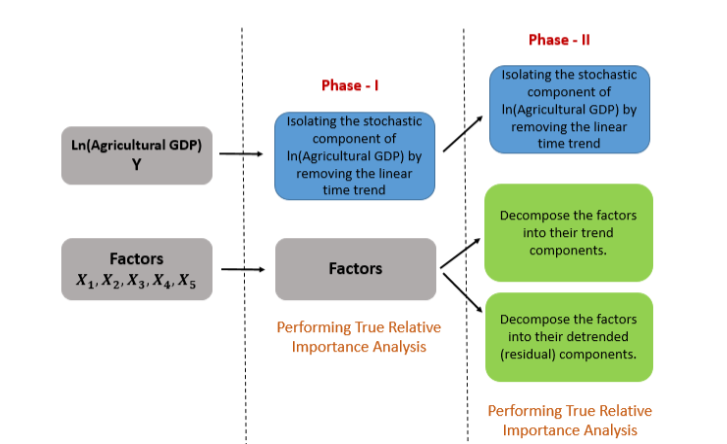
This study examines the relative importance of irrigated area, non-irrigated area, fertilizer use, rainfall, and temperature in explaining agricultural output fluctuations in India during 1960–61 to 2022–23. The analysis uses the True Relative Importance (TRI) framework based on orthopartial and simple correlation. Rainfall emerges as the most important factor when agricultural fluctuations are analyzed without separating trend and de-trended components. Agricultural output remains highly sensitive to monsoon variability. After decomposition, the trend components explain only about 2 percent of total fluctuations. This indicates that factors such as irrigation expansion, fertilizer use, and technological progress mainly influence long-run agricultural growth and stability. The de-trended components account for nearly 65 percent of total fluctuations, showing that agricultural instability is driven largely by short-run factors. Irrigated area is the largest contributor, explaining about 34.7 percent of fluctuations. Rainfall ranks second with 16.6 percent, followed by fertilizer with 9.9 percent. The effects of non-irrigated area and temperature remain relatively small.
Downloads
Published
How to Cite
Issue
Section
Copyright (c) 2026 Rajib Kumar Dolai, Debasish Mondal

This work is licensed under a Creative Commons Attribution 4.0 International License.