Effect of exercise program on health-related quality of life (QOL) in congestive cardiac failure patients
Keywords:
Effectiveness, Exercise Program, Quality of Life, Congestive Cardiac FailureAbstract
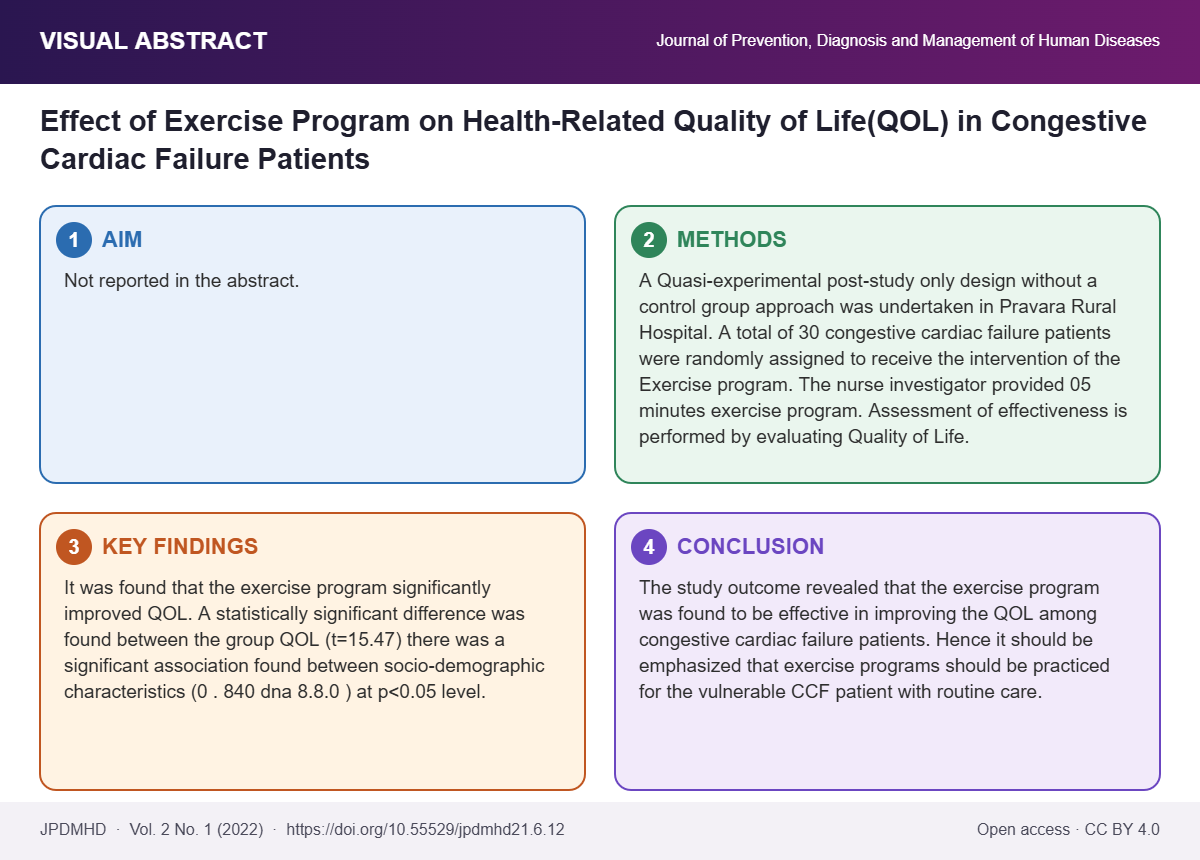
Heart Failure is a common cardiovascular condition with increasing incidence and prevalence. Congestive cardiac failure continues to be a major cause of death throughout the world despite dramatic advances made in the treatment over the last 25 years. As it is growing and people are affected by it, the nurse has an important role in helping the people to live with the disease and control it through various preventive and therapeutic measures. Exercise and education programs are designed to improve the patient’s quality of life after a heart failure or another heart problem. It includes a program of structured exercise that is now generally believed not only to improve morbidity but also to reduce mortality in patients who have suffered a CCF. Material and Method: A Quasi-experimental post-study only design without a control group approach was undertaken in Pravara Rural Hospital. A total of 30 congestive cardiac failure patients were randomly assigned to receive the intervention of the Exercise program. The nurse investigator provided 05 minutes exercise program. Assessment of effectiveness is performed by evaluating Quality of Life. The data were analyzed with descriptive and inferential statistics, wherever required. Results: It was found that the exercise program significantly improved QOL. A statistically significant difference was found between the group QOL (t=15.47) there was a significant association found between socio-demographic characteristics (0 . 840 dna 8.8.0 ) at p<0.05 level. Conclusion: The study outcome revealed that the exercise program was found to be effective in improving the QOL among congestive cardiac failure patients. Hence it should be emphasized that exercise programs should be practiced for the vulnerable CCF patient with routine care.
References
Kumar S, Preetha G. Health promotion: an effective tool for global health. Indian J Community Med. 2012;37(1):5-12. doi:10.4103/0970-0218.94009.
National Research Council (US); Institute of Medicine (US); Woolf SH, Aron L, editors. The U.S. Health in International Perspective: Shorter Lives, Poorer Health. Washington (DC): National Academies Press (US); 2013. 7.
Savarese, Gianluigi, and Lars H Lund. “Global Public Health Burden of Heart Failure.” Cardiac failure review vol. 3,1 (2017): 7-11. doi:10.15420/cfr.2016:25:2
Savarese G, Lund LH. Global Public Health Burden of Heart Failure. Card Fail Rev. 2017Apr;3(1):7-11.
Buttar HS, Li T, Ravi N. Prevention of cardiovascular diseases: Role of exercise, dietary interventions, obesity, and smoking cessation. Exp Clin Cardiol. 2005;10(4):229-249.
Son YJ, Choi J, Lee HJ. Effectiveness of Nurse-Led Heart Failure Self-Care Education onHealth Outcomes of Heart Failure Patients: A Systematic Review and Meta-Analysis. Int J Environ Res Public Health. 2020;17(18):6559. Published 2020 Sep 9. doi:10.3390/ijerph17186559.
Heo S, Lennie TA, Okoli C, Moser DK. Quality of life in patients with heart failure: ask the patients. Heart Lung. 2009;38(2):100-108. doi:10.1016/j.hrtlng.2008.04.002.
Published
How to Cite
Issue
Section
Copyright (c) 2022 Authors

This work is licensed under a Creative Commons Attribution 4.0 International License.
Article history
- Received: 22 September 2021
- Accepted: 12 December 2021
- Published: 18 January 2022
