Role of salivary biomarkers in early detection of chronic kidney disease among hypertensive individuals
Keywords:
Chronic Kidney Disease, Hypertension, KIM-1, Cystatin C, Non-Invasive Diagnostics, Glomerular Filtration RateAbstract
Background: The prevalence of chronic kidney disease (CKD) is approximately 10% of the world population with hypertension being the second most significant contributor of CKD truly causing renal failure and diminishing renal function, which is a highly modifiable risk factor. Traditional diagnostic indicators (serum creatinine and estimated glomerular filtration rate (eGFR)) have some flaws in recognizing renal damage at an early stage.
Objective: To measure the diagnostic capability of salivary biomarkers in early CKD detection in hypertensive people.
Methods: An analytical study was done on a cross-sectional analysis of 600 adult participants (Group A 200 hypertensive patients with CKD, Group B 200 hypertensive patients without CKD and Group C 200 normotensive controls). Salivary biomarkers of nine salivary proteins were studied: urea, creatinine, cystatin C, interleukin-18 (IL-18), neutrophil gelatinase-associated lipocalin (NGAL), kidney injury molecule-1 (KIM-1), beta-2 microglobulin, uric acid and alpha-amylase. One-way ANOVA and receiver operating characteristic (ROC) curve analysis was used in statistical analysis.
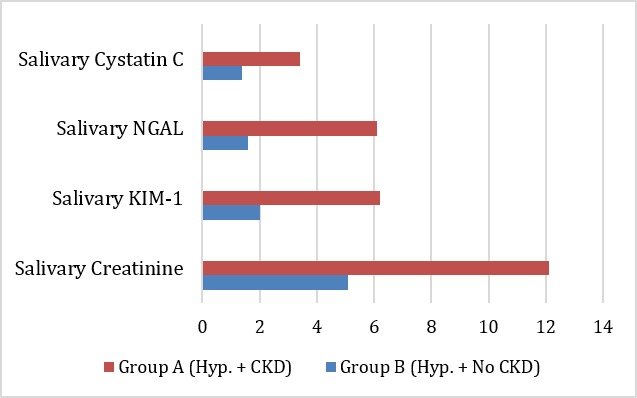
Results: The three groups were significantly different regarding all the biomarkers (p < 0.001). The salivary creatinine (AUC = 0.924), KIM-1 (AUC = 0.917), and NGAL (AUC = 0.908) had high diagnostic performance, as shown in the ROC analysis. An integrated biomarker panel (creatinine, KIM-1, NGAL, and cystatin C) was found to have the best diagnostic ability with AUC of 0.968, sensitivity of 93.5 and specificity of 95.0.
Conclusion: The salivary biomarker profiling holds a high potential as non-invasive screening method in recognizing early cases of CKD in hypertensive patients, and can be used in future point-of-care diagnostic methods.
References
K. Kalantar-Zadeh, P. Jafar, D. Nitsch, B. L. Neuen, and V. Perkovic, "Chronic kidney disease," Lancet, vol. 398, no. 10302, pp. 786-802, Aug. 2021. doi.org/10.1016/S0140-6736(21)00519-5
V. Jha, G. Garcia-Garcia, K. Iseki, Z. Li, S. Naicker, B. Plattner, R. Saran, A. Y. Wang, and C. W. Yang, "chronic kidney disease: global dimension and perspectives," Lancet, vol. 382, no. 9888, pp. 260-272, Jul. 2013. doi.org/10.1016/S0140-6736(13)60687-X
G. L. Bakris and E. Ritz, 'The message for World Kidney Day 2009: hypertension and kidney disease - a marriage that should be prevented', Clin. J. Am. Soc. Nephrol, vol. 4, no. 3, pp. 517-519, Mar. 2009. doi.org/10.2215/CJN.00080109
A. S. Levey et al., 'National Kidney Foundation practice guidelines for chronic kidney disease', Ann. Intern. Med, vol. 139, no. 2, pp. 137-147, July 2003. doi.org/10.7326/0003-4819-139-2-200307150-00013
B. C. Haller, S. H. Bansal, R. H. Bhatt, and A. Y. Vaidya, "Hypertension management in chronic kidney disease," Kidney Int. Rep., vol. 6, no. 1, pp. 4–18, Jan. 2021, doi.org/10.1016/j.ekir.2020.10.023.
D. T. Wong, "Salivary diagnostics," Oper. Dent., vol. 37, no. 6, pp. 562-570, Nov. 2012 doi.org/10.2341/12-143-BL
A. Mese and R. Matsuo, 'Salivary secretion, taste and hyposalivation', J. Oral Rehabil, vol. 34, no. 10, pp. 711-723, Oct. 2007. doi.org/10.1111/j.1365-2842.2007.01794.x
T. J. Lasisi, Y. R. Raji, and B. L. Salako, "Salivary creatinine and urea analysis in patients with chronic kidney disease: a case control study," BMC Nephrol., vol. 17, art. no. 10, Jan. 2016. doi.org/10.1186/s12882-016-0222-x
S. Karbovska, O. Sulkova, and M. Hruby, "Salivary creatinine as a potential biomarker of chronic kidney disease," Clin. Biochem., vol. 47, no. 10–11, pp. 897–901, Jul. 2014, doi.org/10.1016/j.clinbiochem.2014.03.009.
S. S. Haase-Fielitz, M. Haase, and P. Devarajan, "Neutrophil gelatinase-associated lipocalin as a biomarker of acute and chronic kidney disease," Curr. Opin. Nephrol. Hypertens., vol. 23, no. 5, pp. 431–444, Sep. 2014, doi.org/10.1097/MNH.0000000000000047.
J. J. Wang and J. Attia, 'Study designs in epidemiology and levels of evidence', Am. J. Ophthalmol, vol. 149, no. 3, pp. 367-370, Mar. 2010. doi.org/10.1016/j.ajo.2009.08.001
S. Kawas, Z. H. Rahim, and D. B. Ferguson, 'Salivary diagnostics: oral health and beyond!', Arch. Oral Biol, vol. 57, no. 1, pp. 1-9, Jan. 2012. doi.org/10.1016/j.archoralbio.2011.06.013
G. D. Proctor and G. H. Carpenter, 'Regulation of salivary gland function by autonomic nerves', Auton. Neurosci, vol. 133, no. 1, pp. 3-18, June 2007. doi.org/10.1016/j.autneu.2006.10.006
D. Bolignano, A. Lacquaniti, G. Coppolino, S. Campo, A. Arena, and M. Buemi, 'Neutrophil gelatinaseassociated lipocalin reflects the severity of renal impairment in subjects affected by chronic kidney disease', Kidney Blood Press. Res, vol. 31, no. 4, pp. 255-258, 2008. doi.org/10.1159/000143726
V. S. Vaidya et al., 'Regression of microalbuminuria in type 1 diabetes is associated with lower levels of urinary tubular injury biomarkers, kidney injury molecule-1, and N-acetyl-β-d-glucosaminidase', Kidney Int, vol. 79, no. 4, pp. 464-470, Feb. 2011. doi.org/10.1038/ki.2010.404
A. S. Levey et al., 'A new equation to estimate glomerular filtration rate', Ann. Intern. Med, vol. 150, no. 9, pp. 604-612, May 2009. doi.org/10.7326/0003-4819-150-9-200905050-00006
V. Ramesh, R. Ahuja, N. Kumar, P. Meena, A. Chauhan, and D. Bhargava, "Role of salivary interleukin- 18 in diagnosis of chronic kidney disease and its correlation with stages," J. Lab. Physicians, vol. 12, no. 3, pp. 176–181, Sep. 2020, doi.org/10.1055/s-0040-1721163.
G. T. C. R. Pallos, F. R. F. Leite, R. Pannuti, L. Gingold, and A. Romito, "Salivary and blood urea and creatinine levels in non-dialysis chronic kidney disease: A systematic review," Arch. Oral Biol., vol. 101, pp. 34–41, May 2019, doi.org/10.1016/j.archoralbio.2019.02.013.
X. Zhou, E. C. Obuchowski, and H. D. Mcclish, Statistical Methods in Diagnostic Medicine. Wiley, 2011. doi.org/10.1002/9780470906514
K. F. Schulz and D. A. Grimes, 'Case-control studies: Research in reverse', Lancet, vol. 359, no. 9304, pp. 431-434, Feb. 2002. doi.org/10.1016/S0140-6736(02)07605-5
J. A. Navazesh and S. K. S. Kumar, 'Measuring salivary flow: Challenges and opportunities', J. Am. Dent. Assoc, vol. 139, no. 5, pp. 35S-40S, May 2008. doi.org/10.14219/jada.archive.2008.0353
P. A. Hanley and B. J. McNeil, "A method of comparing the areas under receiver operating characteristic curves derived from the same cases," Radiology, vol. 148, no. 3, pp. 839-843, Sep. 1983 doi.org/10.1148/radiology.148.3.6878708
D. E. Weaver, M. J. P. Soni, and J. A. Yudkin, "Improvement of early detection of chronic kidney disease using combined biomarker panels," Nephrol. Dial. Transplant., vol. 30, no. 8, pp. 1254–1262, Aug. 2015, doi.org/10.1093/ndt/gfu393
C. Elendu et al., 'Comprehensive review of current management guidelines of chronic kidney disease', Medicine (Baltimore), vol. 102, no. 23, June 2023. doi.org/10.1097/MD.0000000000033984
N. R. Poulter, D. Prabhakaran, and M. Caulfield, "Hypertension," Lancet, vol. 386, no. 9995, pp. 801- 812, Aug. 2015, doi.org/10.1016/S0140-6736(14)61468-9
Published
How to Cite
Issue
Section
Copyright (c) 2025 Ayesha Sara

This work is licensed under a Creative Commons Attribution 4.0 International License.
