Bridging education, knowledge, and skills: a theoretical framework
Keywords:
Education, Knowledge, Skills, The EKS Model, Systematic Framework.Abstract
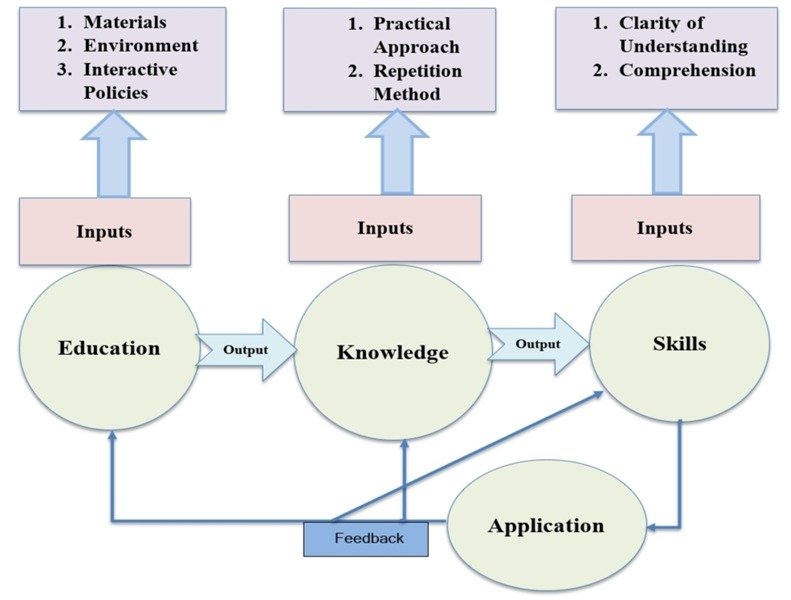
The Education-to-Knowledge-to-Skills (EKS) Progression Model presents a systematic framework that upholds the sequential movement from education to practical skills, and the crucial role of knowledge as an intermediary stage, specially in the context of effective classroom management in this digitalized world. This model hopefully proposes that education forms the foundation by providing essential theoretical understanding via high-quality materials, interactive teaching, and conducive learning environments. Consequently, education emerges as the basis for knowledge attainment which is refined and internalized through practical engagement and repetition process. When knowledge becomes deeper systematically and gradually, it turns into skills that can be applied efficiently in the real-life applications, leading to a more sustainable and tangible outcome. This theoretical model obtains a structured development. Here, each stage builds upon the previous one, resulting in a logical flow. The movement from education to knowledge, and to skills may seem a linear, sequential process that supports the development of practical abilities, but it can be seen as a continuous cycle in case of improving gathered outcomes as well. With the alignment of theory and practical application, it provides a comprehensive framework for skill development and ensures that learners are well equipped to meet the demands and challenges of the modern world. Furthermore, the methodology follows a conceptual, theoretical, and qualitative approach, systematically analyzing inputs of the education, knowledge, and skills phases and bridging them sequentially with one another by the output dependency.
Published
How to Cite
Issue
Section
Copyright (c) 2025 Md. Yeasir Arafat, Fahmida

This work is licensed under a Creative Commons Attribution 4.0 International License.