Creating a score to assess weighting impacts of smartphone addiction among health and medical students
Keywords:
Smartphone Addiction, Psychological Problems, Social Problems, Physical Problems.Abstract
Background: Smartphone addiction among university students is becoming a real public health issue, with reported physical and psycho-social results. But, there aren’t that many tools already validated to help weigh, and basically give a score, to the relative contribution of its different domains.
Objective: The goal of this study was to build a new measurement score that could estimate how much importance is in the extracted factors, as they reflect the weighted contribution of the proposed domains, so we can check the current status of smartphone addiction and its effects, specifically among medical and health college students.
Method: This cross-sectional work used a convenience sample of 772 people, recruited across different academic levels in the medical and health faculties at Kirkuk University. We gathered data through the Smartphone Addiction Scale (SAS) , the Nordic Musculoskeletal Questionnaire, and a twelve-item scale used for measuring how severe Digital Vision Syndrome (DVS) is. For analysis, we applied principal component factor analysis in SPSS, version 22.
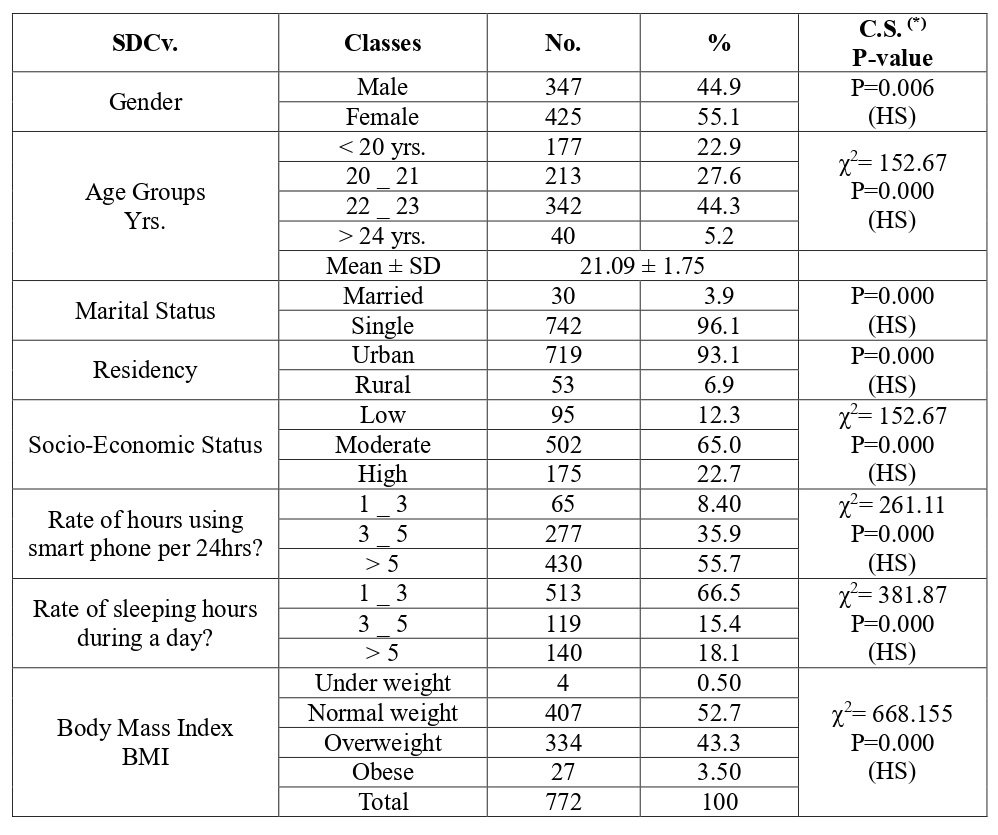
Result: The final sample included 347 males (44.9%) and 425 females (55.1%) , and the mean age was 21.09 ± 1.75 years. Preliminary results indicated strong significant associations (P < 0.01) among the domains that were studied. The factor analysis produced two main components, explaining 67.22% and 32.78% of the total covariance, and these were named the “Psycho-Socio Impact Factor” and the “Physical Impact Factor”.
Conclusion: It was pretty clear that two main things came up. First, a psycho-socio factor seems tied to the family setup, the surrounding environment, and psychological aspects ,things like stress or coping. Second , there is a physical impact factor linked more to vision and musculoskeletal health, so basically what the body does while using a smartphone.
Published
How to Cite
Issue
Section
Copyright (c) 2024 Ammar Ali Asghar Khalil, Hewa Sattar Salih, Abdulkhaleq A Ali Ghalib

This work is licensed under a Creative Commons Attribution 4.0 International License.