Personalized medicine: evolution, applications, challenges, and future directions
Keywords:
Personalized Medicine, Genomics, Pharmacogenomics, Precision Oncology, Digital Health, Health Equit.Abstract
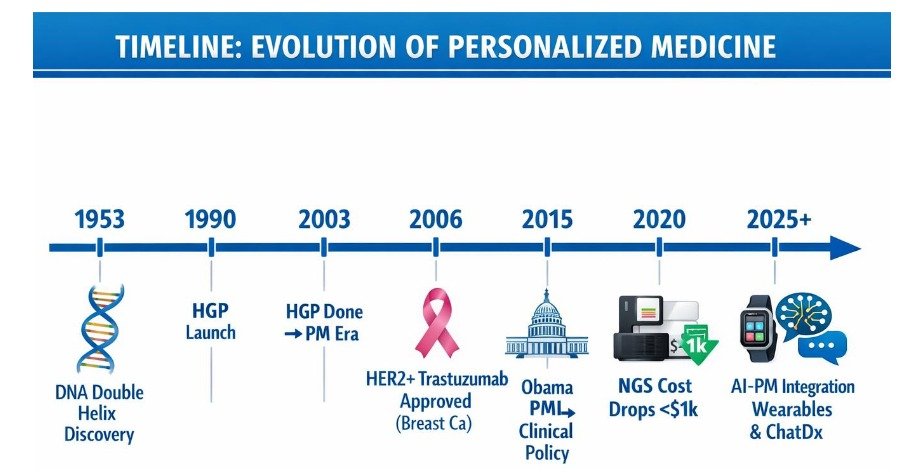
Background: Personalized medicine represents a paradigm shift from population-based toward individualized, data-driven clinical practice, accelerated by genomics, next-generation sequencing, and artificial intelligence.
Objective: To examine the developmental trajectory, scientific foundations, research domains, ethical considerations, and implementation challenges of personalized medicine.
Methods: A narrative review synthesizing literature across genomics, pharmacogenomics, precision oncology, proteomics, biomarker diagnostics, and AI-assisted clinical decision support.
Results: Genomic medicine and pharmacogenomics optimize therapeutic selection while reducing adverse reactions. Precision oncology utilizes molecular tumour profiling for targeted therapy. AI-assisted decision support enhances real-time treatment personalization. However, clinical adoption is constrained by high costs, inadequate infrastructure, workforce skill gaps, and complex data interpretation. Ethical concerns include genetic privacy, discrimination risk, and health equity disparities, with significant implementation gaps persisting between high- and low-income regions.
Conclusions: Personalized medicine has become a cornerstone of contemporary healthcare. Sustainable integration requires robust regulatory frameworks, expanded education, cost-reduction strategies, and international collaboration to ensure equitable global access.
Published
How to Cite
Issue
Section
Copyright (c) 2026 Ravi Rai Dangi, Priya Naik, Sandarbh Vyas, Nikesh Kumar

This work is licensed under a Creative Commons Attribution 4.0 International License.