Prevalence of subclinical hypothyroidism in women with recurrent pregnancy loss and its association with autoimmune markers
Keywords:
Recurrent Pregnancy Loss, Subclinical Hypothyroidism, Thyroid Autoimmunity, TPO Antibodies, Antinuclear Antibodies, MiscarriageAbstract
Background: Recurrent pregnancy loss (RPL), which is defined as two or more consecutive pregnancy losses experienced prior to 20 weeks of pregnancy, causes women all over the world to experience some at least 1-5% pregnancies. Subclinical hypothyroidism (SCH), thyroid autoimmunity has been proposed to be some of the factors contributing to RPL especially in areas where routine thyroid screening when receiving reproductive care is not common.
Objective: The objective of this study was to identify the frequency of SCH in women with the RPL, compare thyroid and autoimmune marker levels between RPL and the control group and determine the relationship between SCH and thyroid autoantibodies and RPL risk.
Methods: It was a three-tier case-control study carried out in three-tier hospitals in India that included 150 women with RPL and 150 matched controls aged and with a BMI of 18 years and above, who had at least one pregnancy that resulted in at least one successful birth. Blood samples were studied in terms of thyroid-stimulating hormone (TSH), free thyroxine (fT4), thyroid peroxidase antibodies (TPO-Ab), thyroglobulin antibodies (Tg-Ab), antinuclear antibodies (ANA) and anti-double-stranded DNA antibodies. A SCH was considered to be TSH higher than 4.0 mIU/L and normal fT4 levels.
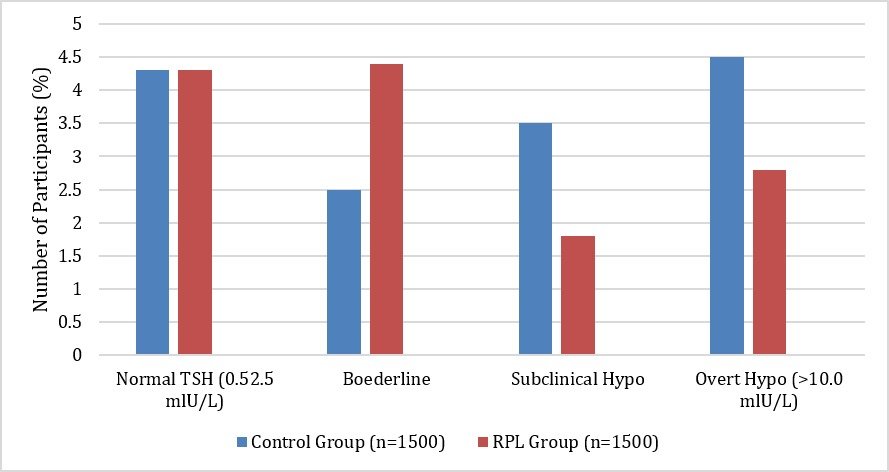
Results: The SCH prevalence was also much greater in the RPL group as compared to that of controls (34.0% vs. 9.3%; p<0.001). TPO-Ab positivity was also more common among RPL cases (41.3% vs. 12.0%; p<0.001). The comorbidity of SCH and TPO-Ab positivity greatly correlated with RPL (OR 6.94; 95% CI: 3.8212.62). ANA positivity was higher in RPL women (22.0% vs. 8.0%; p<0.001). SCH was found as an independent predictor of RPL because of logistic regression with the OR 4.82 and TPO-Ab positivity (OR 3.47).
Conclusion: RPL is profoundly connected with SCH and thyroid autoimmunity. Regular thyroid and autoimmune screening in RPL screening can be used to determine the risk factors that can be modified and lead to better pregnancy outcomes.
References
N. J. van den Berg, M. H. van den Berg, and J. A. Land, “Thyroid function in recurrent miscarriage: a systematic review,” Eur. J. Obstet. Gynecol. Reprod. Biol., vol. 252, pp. 72–79, Sep. 2020, 10.1016/j.ejogrb.2020.05.054.
H. Twig, A. Shina, H. Amital, and Y. Shoenfeld, “Pathogenesis of infertility and recurrent pregnancy loss in thyroid autoimmunity”, J. Autoimmun., vol. 38, no. 2-3, pp. J275-J281, May 2012. 10.1016/j.jaut.2011.11.014
E. Korevaar, S. Melo, S. Pop, and T. Steegers, “Thyroid autoimmunity impairs the thyroidal response to human chorionic gonadotropin: two population-based prospective cohort studies,” J. Clin. Endocrinol. Metab., vol. 102, no. 1, pp. 69–77, Jan. 2017, 10.1210/jc.2016-2942.
A. Thangaratinam, A. Tan, E. Knox, J. J. Kilby, J. Franklyn, and K. S. Khan, “Association between thyroid autoantibodies and miscarriage and preterm birth: meta-analysis of evidence”, BMJ, vol. 342, May 2011. 10.1136/bmj.d2616
B. Velkeniers, A. Van Meerhaeghe, P. Poppe, D. Unuane, T. Tournaye, and J. Haentjens, “Levothyroxine treatment and IVF/ICSI outcome in women with subclinical hypothyroidism undergoing IVF/ICSI: a systematic review and meta-analysis”, Hum. Reprod. Update, vol. 19, no. 3, pp. 251-258, May 2013. 10.1093/humupd/dms052
B. Velkeniers, A. Van Meerhaeghe, P. Poppe, D. Unuane, T. Tournaye, and J. Haentjens, “Levothyroxine treatment and IVF/ICSI outcome in women with subclinical hypothyroidism undergoing IVF/ICSI: a systematic review and meta-analysis”, Hum. Reprod. Update, vol. 19, no. 3, pp. 251-258, May 2013. 10.1093/humupd/dms052
R. Negro, G. Formoso, T. Mangieri, A. Pezzarossa, D. Dazzi, and H. Hassan, “Levothyroxine treatment in euthyroid pregnant women with autoimmune thyroid disease: effects on obstetrical complications,” J. Clin. Endocrinol. Metab., vol. 91, no. 7, pp. 2587-2591, Jul. 2006. 10.1210/jc.2005-1603
P. N. Taylor, M. Minassian, A. Rehman, O. Iqbal, A. Draman, W. Hamilton, and C. Morley, “TSH levels and risk of miscarriage in women on long-term levothyroxine: a community-based study,” J. Clin. Endocrinol. Metab., vol. 99, no. 10, pp. 3895-3902, Oct. 2014. 10.1210/jc.2014-1954
K. Poppe, B. Velkeniers, and D. Glinoer, “Thyroid disease and female reproduction,” Clin. Endocrinol. (Oxf.), vol. 66, no. 3, pp. 309-321, Mar. 2007. 10.1111/j.1365-2265.2007.02752.x
J. G. Hollowell et al., “Serum TSH, T4, and thyroid antibodies in the United States population (1988 to 1994): National Health and Nutrition Examination Survey (NHANES III)”, J. Clin. Endocrinol. Metab., vol. 87, no. 2, pp. 489-499, Feb. 2002. 10.1210/jc.87.2.489
A. Pratt and J. C. Bhatt, “Thyroid-stimulating hormone receptor antibody (TRAb) and recurrent miscarriage: a review,” Reprod. Biomed. Online, vol. 38, no. 4, pp. 541–548, Apr. 2019, 10.1016/j.rbmo.2018.11.024.
S. Benhadi, W. M. Wiersinga, J. B. Reitsma, T. G. Vrijkotte, and G. J. Bonsel, “Higher maternal TSH levels in pregnancy are associated with increased risk for miscarriage, fetal or neonatal death,” Eur. J. Endocrinol., vol. 160, no. 6, pp. 985-991, Jun. 2009. 10.1530/EJE-08-0953
M. F. Prummel and W. M. Wiersinga, “Thyroid peroxidase autoantibodies in euthyroid subjects”, Best Pract. Res. Clin. Endocrinol. Metab., vol. 19, no. 1, pp. 1-15, Mar. 2005. 10.1016/j.beem.2004.11.003
V. J. Muller, A. L. Lindqvist, M. E. Wikland, and J. Hardarson, “Prevalence of thyroid antibodies in subfertile women,” Acta Obstet. Gynecol. Scand., vol. 90, no. 8, pp. 851–857, Aug. 2011, 10.1111/j.1600-0412.2011.01141.x.
T. Maraka et al., “Subclinical hypothyroidism in pregnancy: a systematic review and meta-analysis”, Thyroid, vol. 26, no. 4, pp. 580-590, Apr. 2016. 10.1089/thy.2015.0418
R. Wang, L. Liu, W. Zhang, J. Zhang, K. Wang, and F. Wang, “Association of thyroid autoimmunity and pregnancy outcomes in unexplained recurrent pregnancy loss women: a prospective cohort study,” Front. Endocrinol., vol. 16, art. 1711369, Nov. 2025. 10.3389/fendo.2025.1711369
X. Liu, A. Chen, M. Hu, K. Luo, and B. Huang, “Subclinical hypothyroidism in early pregnancy and the risk of pregnancy complications,” J. Matern. Fetal Neonatal Med., vol. 32, no. 14, pp. 2411–2417, Jul. 2019, 10.1080/14767058.2018.1441280.
G. A. Pasquali, M. Zanotti, A. Marini, P. Cipriani, and P. Meneghini, “Antinuclear antibody positivity and obstetric outcomes: a systematic review,” Autoimmun. Rev., vol. 20, no. 4, p. 102784, Apr. 2021, 10.1016/j.autrev.2021.102784.
H. Dong, N. Wang, Y. Li, and X. Fu, “Association between thyroid autoimmune disease and recurrent pregnancy loss: a meta-analysis,” Front. Endocrinol., vol. 12, p. 635931, Feb. 2021. 10.3389/fendo.2021.774362
A. Kaprara and U. D. Kuhlmann, “The thyroid gland in pregnancy: physiology and pathophysiology,” Hormones (Athens), vol. 14, no. 4, pp. 599–609, Oct. 2015, 10.14310/horm.2002.1640.
E. Abbassi-Ghanavati, L. G. Greer, and F. G. Cunningham, “Pregnancy and laboratory studies: a reference table for clinicians,” Obstet. Gynecol., vol. 114, no. 6, pp. 1326-1331, Dec. 2009. 10.1097/AOG.0b013e3181c2bde8
J. Xie, L. Jiang, A. Sadhukhan, S. Yang, Q. Yao, P. Zhou, J. Rao, and M. Jin, “Effect of antithyroid antibodies on women with recurrent miscarriage: a meta-analysis,” Am. J. Reprod. Immunol., vol. 83, no. 6, art. e13238, Jun. 2020. 10.1111/aji.13238
J. Leung, K. Pearce, J. Stagnaro-Green, and A. El-Tawil, “Subclinical hypothyroidism and adverse pregnancy outcomes: a systematic review and meta-analysis,” J. Obstet. Gynaecol. Can., vol. 40, no. 8, pp. 1005–1018, Aug. 2018, 10.1016/j.jogc.2018.03.014.
D. Glinoer, M. Riahi, J. P. Grün, and J. Kinthaert, “Risk of subclinical hypothyroidism in pregnant women with asymptomatic autoimmune thyroid disorders,” J. Clin. Endocrinol. Metab., vol. 79, no. 1, pp. 197-204, Jul. 1994. 10.1210/jcem.79.1.8027226
Korevaar, M. Medici, T. Visser, and R. Peeters, “Thyroid disease in pregnancy: new insights in diagnosis and clinical management,” Nat. Rev. Endocrinol., vol. 13, no. 10, pp. 610-622, Oct. 2017. 10.1038/nrendo.2017.93
Published
How to Cite
Issue
Section
Copyright (c) 2025 Dr. Priyadharshini P

This work is licensed under a Creative Commons Attribution 4.0 International License.
