Correlation between serum ferritin levels and glycemic control in non-anemic type 2 diabetic patients: a comparative hospital-based study
Keywords:
Serum Ferritin, Type 2 Diabetes Mellitus, Glycemic Control, HbA1c, Insulin Resistance, Hospital-Based StudyAbstract
Background: Serum ferritin, a marker of iron storage, is increasingly recognized as an independent risk factor for insulin resistance and poor glycemic control in type 2 diabetes mellitus (T2DM). However, its relationship with glycemic indices in non-anemic diabetic patients in the Indian population remains underexplored.
Objective: To evaluate serum ferritin levels in non-anemic T2DM patients and assess their association with glycemic control parameters, including fasting blood glucose (FBG), postprandial blood glucose (PPBG), glycated hemoglobin (HbA1c), fasting insulin, and HOMA-IR.
Methods: This comparative cross-sectional study included 120 participants: 60 non-anemic T2DM patients (Group A) and 60 age- and sex-matched healthy controls (Group B). Individuals with anemia, inflammatory, hepatic, or renal disorders, or those on iron supplementation were excluded. Serum ferritin was measured using electrochemiluminescence immunoassay (ECLIA). Statistical analysis was performed using SPSS version 25.0, applying Pearson correlation and one-way ANOVA.
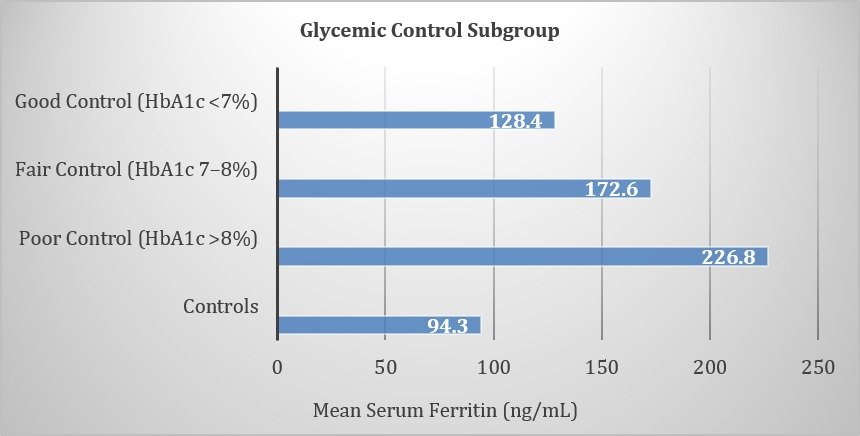
Results: Mean serum ferritin levels were significantly higher in diabetic patients (186.4 ± 74.2 ng/mL) compared to controls (94.3 ± 38.6 ng/mL) (p<0.001). Significant positive correlations were observed between serum ferritin and HbA1c (r=0.693), HOMA-IR (r=0.641), FBG (r=0.612), PPBG (r=0.587), and fasting insulin (r=0.524). Ferritin levels increased progressively across HbA1c categories, with statistically significant differences (p<0.001).
Conclusion: Elevated serum ferritin is strongly associated with poor glycemic control and increased insulin resistance in non-anemic T2DM patients. It may serve as a useful adjunct biomarker for monitoring metabolic control in type 2 diabetes.
References
D. J. Magliano and E. J. Boyko, "IDF Diabetes Atlas: Global, regional and country-level diabetes prevalence estimates for 2021 and projections for 2045", Diabetes Res. Clin. Pract., vol. 183, no. 109119, Jan. 2022. 10.1016/j.diabres.2021.109119
S. Wild, G. Roglic, A. Green, R. Sicree, and H. King, "Global prevalence of diabetes: Estimates for the year 2000 and projections for 2030", Diabetes Care, vol. 27, no. 5, pp. 1047-1053, May 2004. 10.2337/diacare.27.5.1047
A. Fernández-Real, W. Ricart, and J. M. Fernández-Real, "Serum ferritin as a component of the insulin resistance syndrome", Diabetes Care, vol. 21, no. 1, pp. 62-68, Jan. 1998. 10.2337/diacare.21.1.62
P. Dandona, P. Hussain, F. Virdi, D. Bhavani, and E. Muktahar, "Insulin resistance and iron overload," Ann. Clin. Biochem., vol. 20, no. 2, pp. 77-79, Mar. 1983. 10.1177/000456328302000203
M. Tiedge, S. Lortz, R. Munday, and S. Lenzen, "Complementary action of antioxidant enzymes in the protection of bioengineered insulin-producing RINm5F cells against the toxicity of reactive oxygen species," Diabetes, vol. 47, no. 10, pp. 1578-1585, Oct. 1998. 10.2337/diabetes.47.10.1578
C. Bozzini et al., "Prevalence of body iron excess in the metabolic syndrome", Diabetes Care, vol. 28, no. 8, pp. 2061-2063, Aug. 2005. 10.2337/diacare.28.8.2061
R. Singh, A. Barden, T. Mori, and L. Beilin, "Advanced glycation end-products: A review," Diabetologia, vol. 44, no. 2, pp. 129-146, Feb. 2001. 10.1007/s001250051591
S. Rajpathak, J. Ma, J. Manson, W. Willett, and F. B. Hu, "Iron intake and the risk of type 2 diabetes in women", Diabetes Care, vol. 29, no. 6, pp. 1370-1376, June 2006. 10.2337/dc06-0119
C.-H. Kim, H.-K. Kim, S. J. Bae, J.-Y. Park, and K.-U. Lee, "Association of elevated serum ferritin concentration with insulin resistance and impaired glucose metabolism in Korean men and women", Metabolism, vol. 60, no. 3, pp. 414-420, Mar. 2011. 10.1016/j.metabol.2010.03.007
N. Gao, L. Zhang, Y. Li, M. Chen, and Z. Wei, "Elevated serum ferritin as a risk factor for type 2 diabetes mellitus: A meta-analysis," Diabetes Res. Clin. Pract., vol. 139, pp. 262-270, May 2018. 10.1016/j.diabres.2018.03.013
S. C. Tummalacharla et al., "Serum activities of ferritin among controlled and uncontrolled type 2 diabetes mellitus patients", Cureus, vol. 14, no. 5, May 2022. 10.7759/cureus.25155
A. V. Maheshwari, B. K. Bhoi, B. R. Sadariya, H. N. Javia, J. K. Gusani, and H. Sharma, "Correlation between serum ferritin and glycaemic control in patients of type 2 diabetes mellitus: a case control study," Int. J. Res. Med. Sci., vol. 3, no. 9, pp. 2327-2330, Sep. 2015. 10.18203/2320-6012.ijrms20150625
A. Chiu, K. Tsai, C. Lu, P. Lin, and C. Chou, "Relationship between serum ferritin and insulin resistance: Could inflammation or beta-cell dysfunction contribute?" Metabolism, vol. 54, no. 5, pp. 617-621, May 2005. 10.1016/j.metabol.2004.12.010
N. Mohan, S. Deepa, R. Deepa, and V. Mohan, "Serum ferritin is an independent predictor of type 2 diabetes in urban south Indians," Metab. Syndr. Relat. Disord., vol. 6, no. 4, pp. 271-276, Dec. 2008. 10.1089/met.2008.0016
S. C. Tummalacharla et al., "Serum activities of ferritin among controlled and uncontrolled type 2 diabetes mellitus patients", Cureus, vol. 14, no. 5, p. e25155, May 2022. 10.7759/cureus.25155
T. H. Kim and H. J. Kim, "Association between serum ferritin and glycated hemoglobin in non-anemic type 2 diabetic patients," Diabetes Metab. J., vol. 37, no. 3, pp. 214-219, Jun. 2013. 10.4093/dmj.2013.37.3.214
A. Ford and R. Cogswell, "Diabetes and serum ferritin concentration among U.S. adults," Diabetes Care, vol. 22, no. 12, pp. 1978-1983, Dec. 1999. 10.2337/diacare.22.12.1978
M. Ishizaka, Y. Toda, T. Tani, S. Koike, and S. Hanefeld, "Serum ferritin as an indicator of metabolic syndrome in urban Japanese subjects," J. Epidemiol., vol. 15, no. 5, pp. 180-186, Sep. 2005. 10.2188/jea.15.180
American Diabetes Association, "Standards of Medical Care in Diabetes—2023," Diabetes Care, vol. 46, suppl. 1, pp. S1-S291, Jan. 2023. 10.2337/dc23-S001
World Health Organization, Definition and Diagnosis of Diabetes Mellitus and Intermediate Hyperglycaemia. Geneva: WHO, 2006. 10.1002/dmrr.568
V. Salonen, P. Nyyssönen, T. Korpela, K. Salonen, and J. T. Salonen, "High stored iron levels are associated with excess risk of myocardial infarction in eastern Finnish men", Circulation, vol. 86, no. 3, pp. 803-811, Sept. 1992. 10.1161/01.CIR.86.3.803
A. Facchini, S. Ida, C. Sartori, A. Ponchio, and R. Campagna, "Relationship between dietary iron intake and insulin resistance," J. Am. Coll. Nutr., vol. 21, no. 5, pp. 441-448, Oct. 2002. 10.1080/07315724.2002.10719245
A. W. Hounslow, C. S. Higgins, K. A. Moore, A. Jackson, and A. C. Newman, "Ferritin, transferrin and diabetes: A critical review," Diabet. Med., vol. 30, no. 4, pp. 385-394, Apr. 2013. 10.1111/dme.12162
Published
How to Cite
Issue
Section
Copyright (c) 2025 Dr. Priyadharshini. P

This work is licensed under a Creative Commons Attribution 4.0 International License.
