MAIN MENU
Peer Review Process
Peer Review Process
The Journal of Artificial Intelligence, Machine Learning and Neural Network (JAIMLNN) is a refereed journal that operates a double-blind peer-review process, in which the identities of authors and reviewers remain mutually anonymous throughout. Every submission undergoes initial editorial screening followed by external review by two independent expert reviewers.
Editorial decisions (Accept, Minor Revision, Major Revision or Reject) are communicated to authors with reviewer comments within a target of 8–12 weeks of submission, in line with the HM Publishers peer-review policy. Accepted articles are normally published online within 4 weeks of acceptance, so the full process, through to final online publication, normally takes 12–16 weeks, depending on the number of revision rounds and author response time.
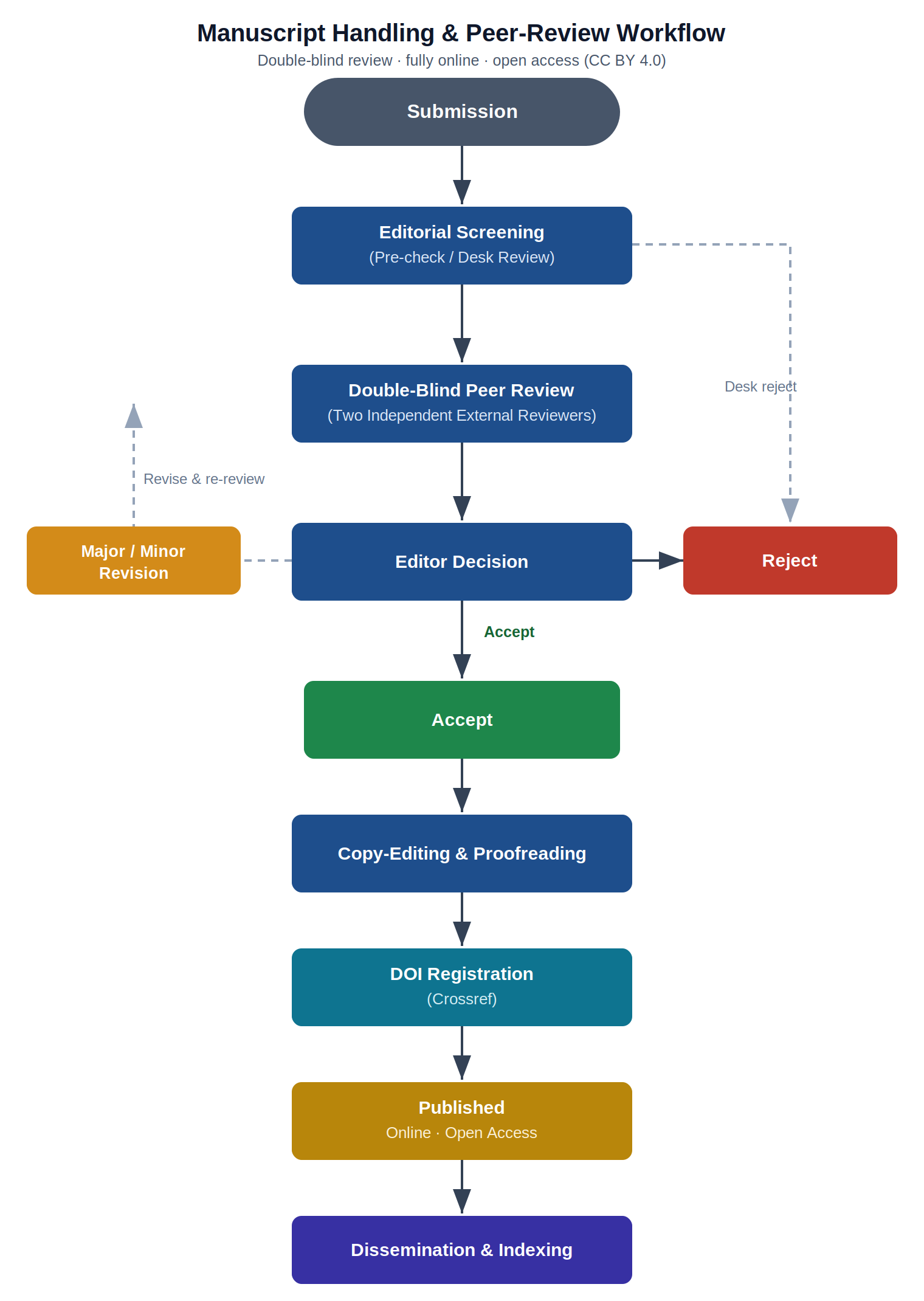
Step 1 — Editorial Screening (Pre-check)
On receipt, the Editor-in-Chief (or an assigned Handling Editor) screens the manuscript for scope, originality, structure, language, and compliance with the journal's ethical and formatting requirements. Manuscripts that fall outside the aims and scope, duplicate existing work, or are incomplete or poorly prepared may be rejected at this stage without external review (desk rejection). Authors are normally informed of a desk rejection within three weeks of receipt.
Step 2 — Double-Blind Peer Review
Manuscripts that pass screening are sent to two independent external reviewers with relevant subject expertise. Author-identifying information is removed from the files provided to reviewers, and reviewer identities are not disclosed to authors. Reviewers assess originality, significance, technical soundness, methodology, clarity, ethical compliance, and adequacy of references, and return a recommendation with supporting comments. Where the two reports diverge, the Handling Editor may invite an additional referee.
Step 3 — Editorial Decision
Based on the reviewers' reports, the editor reaches one of the following decisions: accept; accept with minor revisions; major revision (re-review required); or reject. The decision, together with the reviewers' anonymized comments, is communicated to the corresponding author. Authors invited to revise should return the revised manuscript, with a point-by-point response to the reviewers, within the period stated in the decision letter.
Step 4 — Revision and Re-review
Revised manuscripts are evaluated by the editor and, where necessary, returned to the original or new reviewers for a further round of review. One round of major revision is normally permitted; minor corrections may be verified by the editor directly.
Step 5 — Final Decision
The Editor-in-Chief makes the final decision on acceptance or rejection and may consult members of the Editorial Board where appropriate. The Editor-in-Chief's decision is final.
Post-Acceptance
Accepted manuscripts undergo copy-editing and proofreading, are assigned a Crossref DOI and are then published in the next available issue as fully open-access articles under a Creative Commons Attribution 4.0 (CC BY 4.0) licence. Published articles are disseminated and made available for indexing.
Special Issues
JAIMLNN does not publish special issues. Every paper is handled through the regular editorial process described above, including double-blind review by at least two independent external reviewers. If the journal introduces special issues in future, this page will first be updated to describe how they are proposed, how guest editors are vetted and approved, and how the Editor-in-Chief oversees them. Special-issue papers would receive the same external peer review as regular papers, would be clearly labelled, and papers by guest editors would be handled by an independent editor and would not exceed 25% of the issue.
Editorial Independence and Conflicts of Interest
Editors and reviewers must declare any conflict of interest and are excluded from handling manuscripts where such a conflict exists. Where an editor is an author of a submission, an alternative editor or board member is assigned to manage the review independently. Reviewers must treat all manuscripts as confidential.
Publication Frequency
JAIMLNN publishes two issues per year (January–June and July–December).
Contact
For questions about the peer-review process or editorial policies, contact the editorial office at jaimlnn@hmjournals.com.
Reviewers and Editorial Independence
Peer review is carried out by independent external experts in the subject of the manuscript. Reviewers are not members of the journal's editorial staff. Members of the Editorial Board may act as reviewers only for manuscripts they are not handling as editor, and never for their own submissions.
Reviewer Selection and Author-Suggested Reviewers
The Handling Editor selects reviewers based on subject expertise, publication record and absence of conflicts of interest. Reviewer suggestions are made by the editors themselves; no automated or AI-based reviewer-matching tool is used. Authors may suggest up to three potential reviewers and may request that specific individuals be excluded. Suggested reviewers are used only to help identify relevant expertise: the editor is not obliged to invite them, and at least one reviewer of every manuscript is always chosen independently by the editor.
Supplementary Material
Supplementary material (datasets, code, additional figures and tables) is sent to reviewers together with the manuscript and is assessed as part of the peer review. Material that cannot be reviewed is published only with an explicit note that it was not peer reviewed.
Article Types and Exceptions to Peer Review
All research articles, review articles, systematic reviews and review protocols, and short communications undergo double-blind external peer review. Editorials, corrections (errata and corrigenda), retraction notices and expressions of concern are not externally peer reviewed; they are reviewed by the Editor-in-Chief and are clearly labelled by article type. Any individual article that does not follow the usual peer review process will carry a statement saying so on the article page and in the PDF.
Use of Automated Tools in Editorial Screening
All submissions are checked for text similarity using a plagiarism-detection service before review. The similarity report is read and interpreted by an editor; no submission is rejected automatically. The journal does not use generative AI or automated tools to screen manuscripts, make editorial decisions, write editorial comments or request revisions. Reviewers may not use generative AI tools on manuscripts and must not upload any part of a manuscript to such tools (see our Generative AI Policies).
Confidentiality and Contact
Reviewers must keep the manuscript and the review confidential, must not contact the authors directly, and must not involve colleagues or students in the review without first obtaining the editor's permission; anyone who helps must be named to the editor and is bound by the same confidentiality.
Reviewer Guidance and Delays
Reviewers receive written instructions on the journal's expectations, the review form and the deadline (normally 21 days). Editors are trained in the journal's peer review process, conflict-of-interest handling and how to deal with inappropriate reviewer comments, and they are available to answer questions from authors and reviewers at jaimlnn@hmjournals.com. If a decision is delayed beyond the timelines stated above, authors are informed of the reason and offered the option to withdraw their manuscript.