A literature survey on National Education Policy 2020 (NEP 2020) and libraries
Keywords:
NEP 2020, Libraries, Digital Libraries, Library Science, Education Policy, Lifelong Learning.Abstract
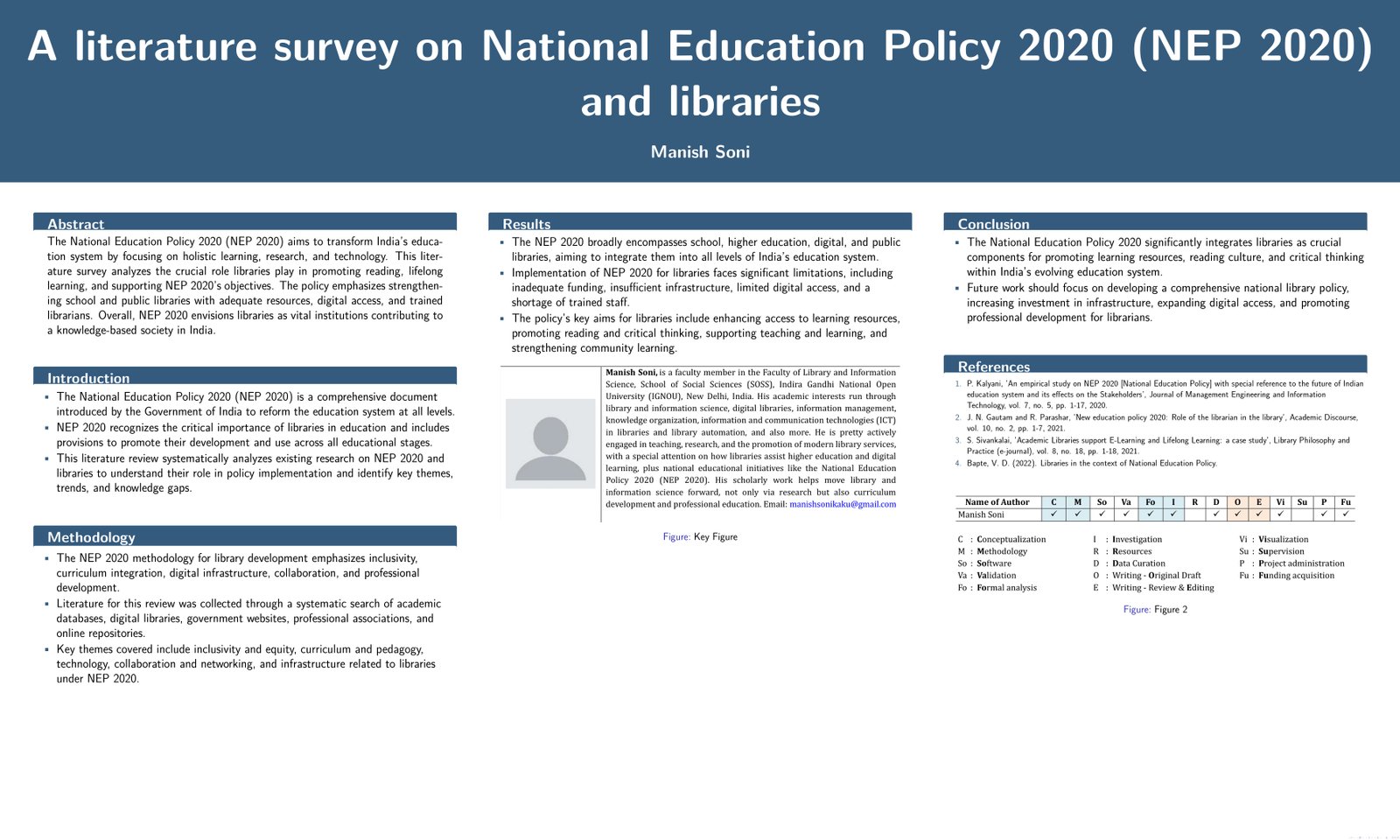
NEP 2020 refers to the National Education Policy 2020, which is a policy document released by the Government of India in July 2020. The NEP 2020 aims to transform the education system in India by focusing on holistic and multidisciplinary education, promoting research and innovation, and incorporating technology into the learning process. In terms of libraries, the NEP 2020 recognizes the crucial role that libraries play in promoting a culture of reading and lifelong learning. The policy emphasizes the need to strengthen school and public libraries by providing them with adequate resources, including books, digital resources, and trained librarians. Furthermore, the NEP 2020 recognizes the need to incorporate technology into library services, such as providing access to e-books, e-journals, and other digital resources. The policy also highlights the importance of promoting local and indigenous knowledge through the development of community libraries. Overall, the NEP 2020 envisions libraries as vital institutions that can contribute to the promotion of a knowledge-based society in India.
References
P. Kalyani, 'An empirical study on NEP 2020 [National Education Policy] with special reference to the future of Indian education system and its effects on the Stakeholders', Journal of Management Engineering and Information Technology, vol. 7, no. 5, pp. 1-17, 2020.
J. N. Gautam and R. Parashar, 'New education policy 2020: Role of the librarian in the library', Academic Discourse, vol. 10, no. 2, pp. 1-7, 2021.
S. Sivankalai, 'Academic Libraries support E-Learning and Lifelong Learning: a case study', Library Philosophy and Practice (e-journal), vol. 8, no. 18, pp. 1-18, 2021.
Bapte, V. D. (2022). Libraries in the context of National Education Policy.
M. R. D. Devkar, NEW NATIONAL EDUCATION POLICY & THE ROLE OF LIBRARIAN" Maharashtra Education Society's (Doctoral dissertation). 2022.
P. S. Aithal and S. Aithal, 'Analysis of the Indian National Education Policy 2020 towards achieving its objectives', Technology, and Social Sciences (IJMTS), vol. 5, no. 2, pp. 19-41, 2020. doi.org/10.47992/IJMTS.2581.6012.0102.
E. S. T. Abumandour, 'Public libraries' role in supporting e-learning and spreading lifelong education: a case study', Journal of Research in Innovative Teaching & Learning, vol. 14, no. 2, pp. 178-217, 2020. doi.org/10.1108/JRIT-06-2019-0063
Saxena, A. The glimpse of NEP 2020. MULTIDISCIPLINARY RESEARCH VOLUME-2, 1.
A. Kumar, New education policy (NEP) 2020: A roadmap for India 2.0. University of South Florida M3, vol. 3. Center Publishing, 2021.
K. Kumar, A. Prakash, and K. Singh, 'How National Education Policy 2020 can be a lodestar to transform future generation in India', Journal of Public affairs, vol. 21, no. 3, 2021. doi.org/10.1002/pa.2500.
S. P. More, 'The national education policy for libraries in India from 1948 to 2020: An analytical study', Delta National Journal Of Multidisciplinary Research, vol. 10, pp. 1-14, 2023. doi.org/10.6025/ijis/2022/14/4/116-126
K. Muralidharan, K. Shanmugan, and Y. Klochkov, 'The New Education Policy 2020, Digitalization and Quality of Life in India: Some Reflections', Education Sciences, vol. 12, no. 2, 2022. doi.org/10.3390/educsci12020075.
L. Krolak, 'The role of libraries in the creation of literate environments', International Journal of Adult and Lifelong Education, vol. 4, no. 1/4, 2006.
J. Shivarama and G. Gujral, Imbibing and Implementation of NEP2020 for Re-imagining Libraries for Research and Development. 2022.
Bandyopadhyay, A. Bardhan, P. Dey, and S. Bhattacharyya, Bridging the Education Divide Using Social Technologies. Springer, 2021. doi.org/10.1007/978-981-33-6738-8.
Published
How to Cite
Issue
Section
Copyright (c) 2023 Manish Soni

This work is licensed under a Creative Commons Attribution 4.0 International License.