Thermal stress-induced modulation of productive performance, physiological responses, and animal welfare in dairy cattle and buffalo across South Asian agro-climatic zones: a multi-regional longitudinal study
Keywords:
Thermal Stress, Heat Tolerance, Dairy Cattle, Livestock Welfare, Climate Change, South Asia.Abstract
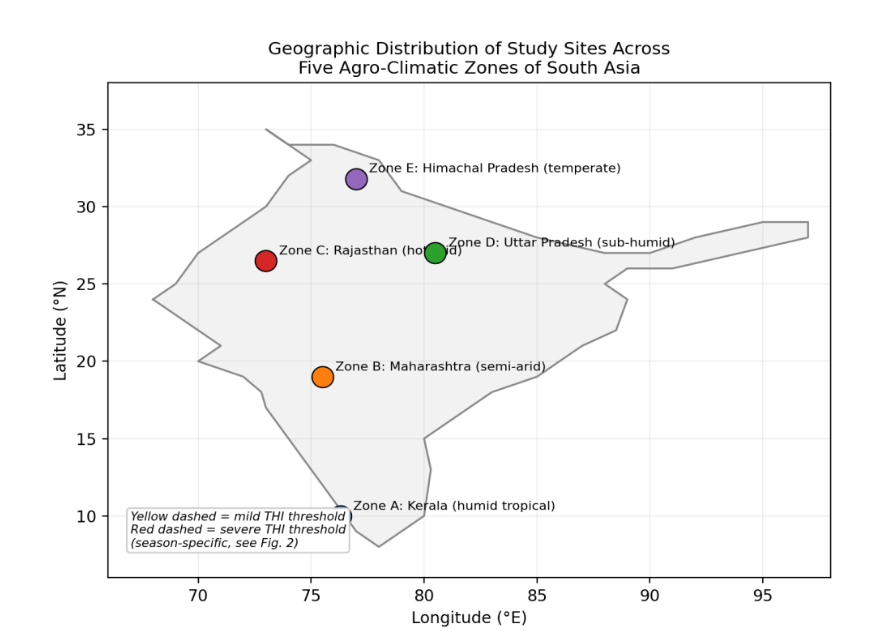
In tropical and subtropical areas, thermal stress is one of the most important limiting factors for livestock productivity and welfare and is likely to increase under climate change. The impact of Temperature-Humidity Index (THI) on productive, physiological and welfare traits of the Holstein-Friesian × Sahiwal crossbred cows, Murrah buffalo, Gir and Kankrej cattle was assessed through a multi-regional longitudinal study in five South Asian agro-climatic regions. The mother 180 adult females were monitored monthly for 24 months (from January 2021 to December 2022). THI was classified as thermoneutral (<72), mild (72–79), moderate (79–88), and severe (>88). Yield of milk was significantly reduced with increasing THI (β = −0.218 L/day per THI unit; R² = 0.683; P < 0.001), while respiration rate, rectal temperature and serum cortisol were increased which were indicators of heat stress. There was a decrease of peripheral blood mononuclear cells indicating heat induced immunosuppression. The heat tolerance of the Gir (84.6 ± 1.4%) and Kankrej (81.2 ± 1.7%) cattle were significantly higher compared to crossbred cattle (72.4 ± 1.8%) (P < 0.05), while Murrah buffalo had intermediate heat tolerance (82.8 ± 1.6%), possibly due to wallowing. When heat stress was moderate or severe, welfare indicators were significantly reduced, such as lying time and ruminations duration. A strong negative relationship between THI and milk yield (r = −0.74; P < 0.001) was detected by Pearson correlation analysis, which indicated that THI was the main factor linking productive, physiological and behavioural traits. The results encourage breed-specific adaptation measures, infrastructure for zones and monitoring of THI for better climate resilient livestock management.
Downloads
Published
How to Cite
Issue
Section
Copyright (c) 2026 Dr. T Rajendran

This work is licensed under a Creative Commons Attribution 4.0 International License.