Artificial intelligence adoption in human resource management: a systematic literature review and future research directions
Keywords:
Artificial Intelligence, Human Resource Management, AI Adoption, HR Analytics, Machine Learning, Predictive Analytics.Abstract
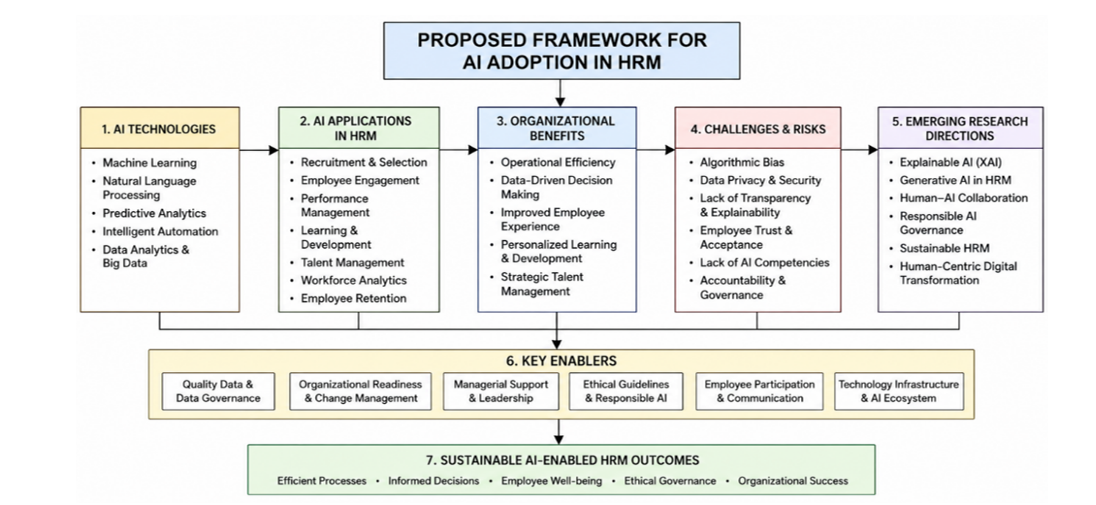
The use of Artificial Intelligence (AI) in Human Resource Management (HRM) is becoming more prevalent through the application of intelligent automation, machine learning, natural language processing, predictive analytics, and data-driven decision-making in HR processes. This article serves as a Systematic Literature Review (SLR) of the uses of AI in HR management and provides an overview of the main uses of AI in HRM as well as the benefits it can provide for organizations, the issues relating to implementing it, and future research directions. The studies and literature are examined in relation to the major functions of HRM, which include recruitment and selection, employee engagement, performance management, learning and development, talent management, workforce analytics, employee retention and turnover, and the results show that AI can make recruitment much more efficient, personalize static employee services, improve workforce planning, and provide valuable assistance with talent development and other things. However, the hurdles that limit effective implementation cover algorithm bias, privacy of data, lack of transparency, limited access to AI methods, trust of employees, and accountability. Further analysis depicted in this review shows that the incorporation of AI has to be seen as an organizational transformation instead of an implementation focused solely on technology whereby AI capabilities, data quality, organizational readiness, managerial expertise, and responsible governance need aligning. New research underlines the concepts of Explainable AI (XAI), Generative AI, human-AI collaboration, all responsible AI implementations, sustainable HMRM, and human-centered digital transformation. The research concludes that the sustainable AI-enabled HRM involves the combination of technological capabilities with human judgment, ethical governance, employees’ well-being as well as organizational objectives. The given research directions are the basis for the development of more transparent, trustworthy, and human-centered AI systems for HRM.
Published
How to Cite
Issue
Section
Copyright (c) 2026 Minakshi Singh, Dwarkadas Prahladadas Kothari, Satyam Singh

This work is licensed under a Creative Commons Attribution 4.0 International License.