About the nootropic properties of donsumine
Keywords:
Motor Activity, Open Field, Scopolamine, CRPA, Amnestic Action, Research Activity.Abstract
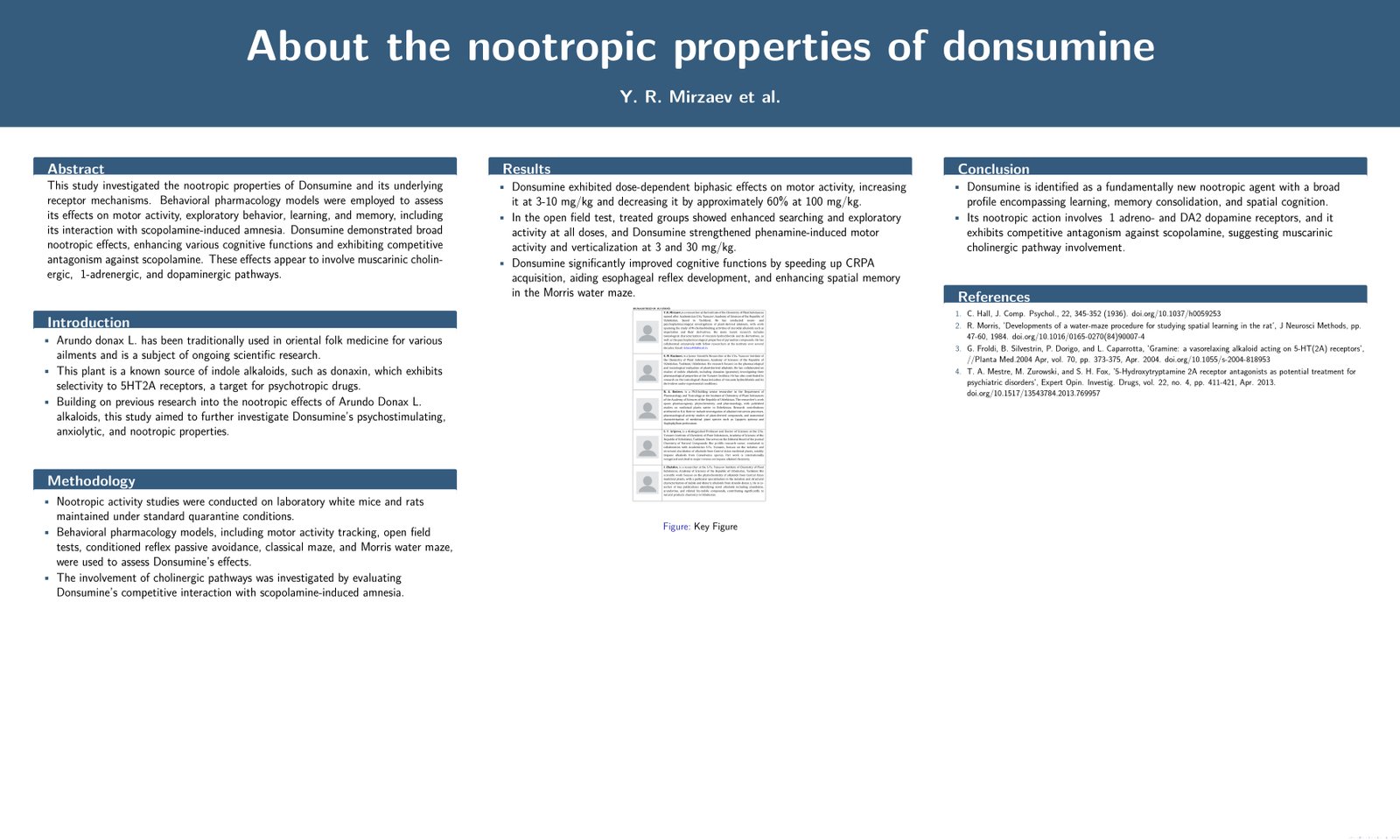
Background: Donsumine shows a kinda clear dose dependent impact on motor activity, also on the exploratory part which lets you look at its nootropic value. In this context, adrenergic receptors (α1) and dopaminergic receptors are often thought of as the main mediators behind nootropic drug effects. Objective: The goal was to describe the nootropic profile of Donsumine, using behavioral pharmacology models, and also to spell out what’s going on at the receptor level, mechanism wise. Methods: Motor activity (MA) and verticalization were tracked across doses from 3–100 mg/kg, like repeatedly and in a controlled way. Then, the phenamine induced MA boost was checked at 3 and 30 mg/kg. As for exploratory behavior, they used the open field test (Hall paradigm) at 1, 10, and 100 mg/kg. Nootropic performance was assessed through conditioned reflex passive avoidance (CRPA), plus a classical maze, specifically the esophageal reflex acquisition, and finally the Morris water maze for spatial memory. To check the cholinergic side, scopolamine induced amnesia was used, and then there was a competitive interaction analysis, to see how it lines up. Results: Donsumine had dose dependent biphasic effects on MA, like it initially ramps up at 3, 5, and 10 mg/kg, and then at 100 mg/kg it drops it by about 60%. It also strengthened phenamine induced MA, and verticalization at 3 and 30 mg/kg, with the effects that lasted through the whole observation window and then returned back to usual after discontinuation. In the open field test, the treated groups showed enhanced searching and more exploratory activity at all doses tested. In the nootropic models, Donsumine sped up CRPA acquisition, helped the esophageal reflex develop in the classical maze, and improved spatial memory in the Morris water maze too. Finally, Donsumine showed competitive antagonism against scopolamine induced amnesia across all cognitive tests, if you look at the pattern as a whole. Conclusions: Donsumine shows a pretty broad nootropic profile, like it helps with learning, memory consolidation, and spatial cognition at the same time. When it is given against scopolamine, the effects look like competitive antagonism, so it seems to involve muscarinic cholinergic pathways, plus α1-adrenergic and dopaminergic mechanisms too. In other words it kinda points to a mix of systems, not just one.
Published
How to Cite
Issue
Section
Copyright (c) 2023 Y. R. Mirzaev, E. M. Ruzimov, R. A. Botirov, S. F. Aripova, I. Zhalalov

This work is licensed under a Creative Commons Attribution 4.0 International License.