Beyond symptom relief: enhancing patient outcomes in sinusitis management through a patient-centered lens
Keywords:
Hypersalivation, Sinusitis, Upper Respiratory Tract, Drainage, Irritation, Symptoms.Abstract
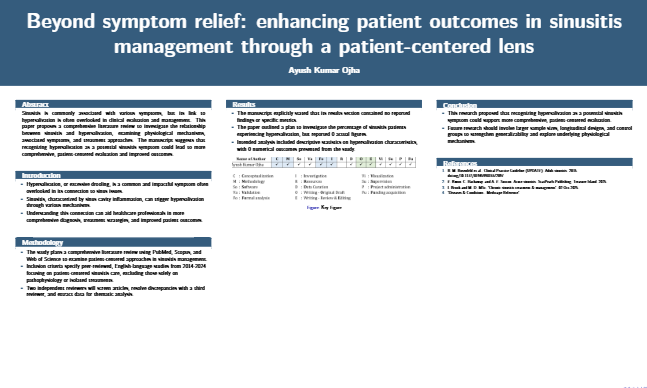
Background: Sinusitis is commonly associated with a range of symptoms, but the association with hypersalivation is often overlooked in clinical evaluation and management.
Objective: To investigate the relationship between sinusitis and hypersalivation by examining underlying physiological mechanisms, associated symptoms, and treatment approaches, informing more comprehensive, patient-centered diagnosis and management strategies.
Methods: A literature review was planned using PubMed, Scopus, and Web of Science, with search terms including "sinusitis management," "patient-centered care," "shared decision-making," "patient engagement," and "health outcomes." Inclusion criteria specified peer-reviewed, English-language studies (2014–2024) addressing patient-centered approaches to sinusitis care across any age group; studies focused solely on pathophysiology, diagnosis, or isolated treatment modalities were excluded. Two independent reviewers were to screen titles, abstracts, and full texts, with disagreements resolved by a third reviewer, followed by data extraction and thematic analysis.
Results: Not reported-the manuscript's Results and Discussion sections contain unfilled placeholder text describing what findings "will likely include" rather than actual extracted data or thematic findings.
Conclusion: The manuscript proposes that recognizing hypersalivation as a potential symptom of sinusitis could support more comprehensive, patient-centered evaluation, but no completed analysis is presented to substantiate this.
References
R. M. Rosenfeld et al., Clinical Practice Guideline (UPDATE): Adult sinusitis. 2015. doi.org/10.1177/0194599815572097
E. Kwon, C. Hathaway, and A. E. Sutton, Acute sinusitis. StatPearls Publishing, Treasure Island, 2025.
I. Brook and M. D. MSc, 'Chronic sinusitis treatment & management', 02-Oct-2025.
'Diseases & Conditions - Medscape Reference'.
M. Khazen et al., 'Anatomy of diagnosis in a clinical encounter: how clinicians discuss uncertainty with patients', BMC Prim. Care, vol. 23, no. 1, p. 153, June 2022. doi.org/10.1186/s12875-022-01767-y
M. Sullivan, The patient as agent of health and health care: Autonomy in patient-centered care for chronic conditions. Oxford, England: Oxford University Press, 2016.
R. J. Stachler et al., 'Clinical practice guideline: Hoarseness (dysphonia) (update)', Otolaryngol. Head Neck Surg., vol. 158, no. 1_suppl, pp. S1-S42, Mar. 2018. doi.org/10.1177/0194599817751030
Saketkoo, L. A., Russell, A., Jensen, K., Mandizha, J., Tavee, J., Newton, J. J., Rivera, F. J., Howie, M., Reese, R. K., Goodman, M., Hart, P. B., Strookappe, B., De Vries, J., Rosenbach, M., Scholand, M. B., Lammi, Elfferich, M., Lower, E. E., Baughman, R. P., . . . Drent, M. (2021). Health-Related Quality of Life (HRQOL) in Sarcoidosis: Diagnosis, management, and health Outcomes. Diagnostics, 11(6), 1089. doi.org/10.3390/diagnostics11061089
E. G. Iglesia, M. Greenhawt, and M. Shaker, 'Achieving the Quadruple Aim to deliver value-based allergy care in an ever-evolving health care system', Annals of Allergy, Asthma & Immunology, vol. 125, no. 2, pp. 126-136, 2020. doi.org/10.1016/j.anai.2020.04.007
J. M. Hildebrand, 'Talking with and about older adult patients: The socializing power of patient-centered communication in an optometry teaching clinic', University of Waterloo, 31-July-2007.
Published
How to Cite
Issue
Section
Copyright (c) 2024 Ayush Kumar Ojha

This work is licensed under a Creative Commons Attribution 4.0 International License.