Pharmacological management of heart failure with preserved ejection fraction: a narrative review of diagnosis, drug classes, and trial evidence
Keywords:
Heart Failure With Preserved Ejection Fraction, HFpEF, Pharmacology, SGLT2 Inhibitors, Mineralocorticoid Receptor Antagonists, Angiotensin Receptor–Neprilysin Inhibitor.Abstract
Introduction: Heart failure with preserved ejection fraction (HFpEF) has recently become the (increased) diagnosis of choice for about 50% of heart failure cases and has been the diagnosis that has been the most refractory to all the treatments that have proven successful for heart failure with reduced ejection fraction (HFrEF) for more than 20 years. No single test can confirm a diagnosis in the case of HFpEF and diagnosis is often deferred or missed. In conclusion, this narrative review summarizes (i) validated diagnostic and risk stratification criteria for HFpEF, and (ii) comparative pharmacology and randomized trial data of the various classes of drugs currently recommended in the management of HFpEF.
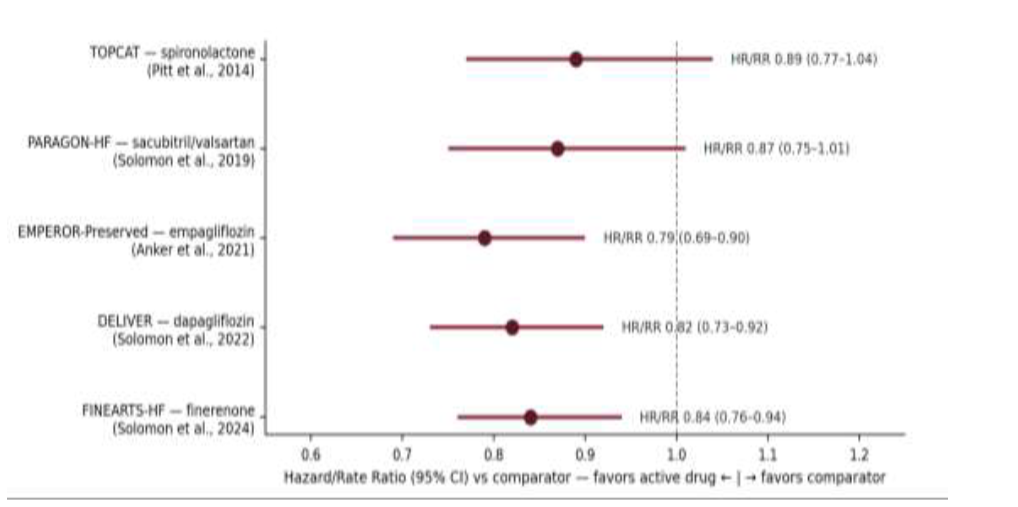
Methods: PubMed/MEDLINE, Cochrane Library and ClinicalTrials.gov were queried for phase 3 randomized outcome trials in HFpEF, along with current HFpEF guidance from the ESC and AHA/ACC/HFSA guidelines 1997-2025. There are nine phase 3 outcome trials, each with over 40,000 patients, being compared candesartan, irbesartan, perindopril, spironolactone, sacubitril/valsartan, empagliflozin, dapagliflozin, finerenone and tirzepatide. Reduced composite of cardiovascular death or hospitalization for heart failure (HR 0.79–0.82) was observed with SGLT2 inhibitors; previous neurohormonal interventions were only weakly or not observed; finerenone had a similar, significant result (RR 0.84). Along with the H₂FPEF score and the HFA-PEFF algorithm, a comparative pharmacology table, a safety/monitoring table, and a phenotype-guided treatment algorithm are presented.
Conclusions: HFpEF is now from a geographically undefined 'syndrome' to one with a number of evidence-based drug classes; the SGLT2 inhibitors form the bases of therapy with phenotypes of therapies added on according to phenotype, followed by the integration of incretin-based classes into HFpEF therapy, where useful, in the obesity phenotype. Early and more effective diagnosis and timely treatment with this proven combination of drugs offers a very significant opportunity to ease the impact of this increasingly common disease affecting human beings.
Published
How to Cite
Issue
Section
Copyright (c) 2025 Abdul Mukit

This work is licensed under a Creative Commons Attribution 4.0 International License.