Automated body condition score assessment across five domestic animal species using a multi-branch deep learning framework: AnimalBCS-Net and the AnimalBCS-1200 benchmark dataset
Keywords:
Deep Learning, Precision Livestock, Animal Welfare, EfficientNet, Grad-CAM, Multi-Species.Abstract
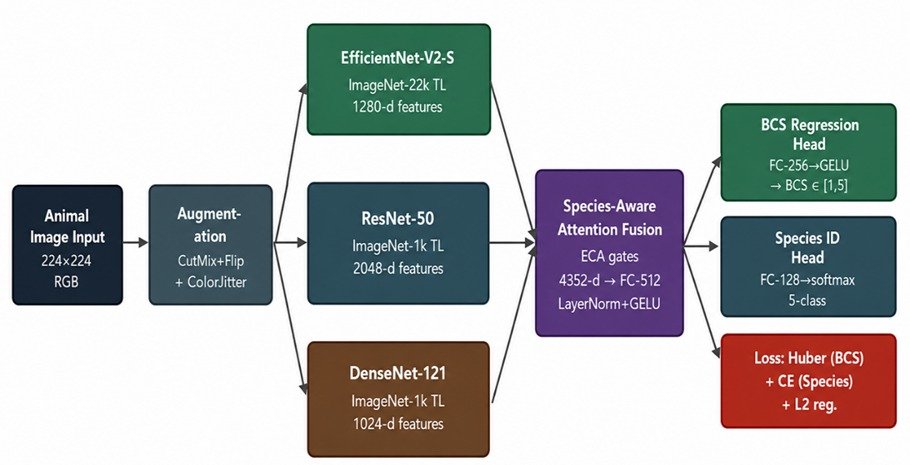
Body condition score (BCS) is an integral part of the routine check-up in all major domestic animal species that provides an accurate assessment of adiposity, provides early warning indicators of metabolic and reproductive disorders, guides feeding management and can be used to monitor nutritional status. But manual BCS is subjective, time-consuming and cannot be performed by most of the smallholder livestock producers around the world. Purpose: This paper introduces AnimalBCS-Net, the first uniform automated BCS framework that is trained and validated for five species of domestic animals (domestic cat, Labrador dog, Holstein dairy cattle, Merino sheep, and Saanen dairy goat) that uses a common deep learning pipeline. For every 25 species–BCS class combination, we present the benchmark dataset of visual data (RGB images) with 1200 images annotated by certified veterinarians according to a species-specific, international standard, called AnimalBCS-1200. AnimalBCS-Net is a combination of three pretrained CNN backbones (EfficientNet-V2-S, ResNet-50, DenseNet-121) through an ECA attention fusion layer, where the species-aware layer is inserted between the three CNN backbones, and then the regression of BCS scale (1–5) and the output of species identification are output from two output heads. On the test split of the AnimalBCS-1200 dataset, the framework yields a mean absolute error (MAE) of 0.23 BCS units, which is far lower than the clinically significant limit of ±0.5, and has an accuracy rate of 96.7% species classification, better than six baselines evaluated. The visualisations provided by Grad-CAM on a real cat image (CC0-licensed, 'Chelsea', scikit-image) show that the model focuses veterinarily-relevant morphological features, such as prominence of spiny back, visibility of ribs and tucked abdomen. The weights for the pretrained models in the AnimalBCS-1200 dataset are released under CC BY 4.0 and the dataset is released publicly under CC BY 4.0.
Downloads
Published
How to Cite
Issue
Section
Copyright (c) 2025 Ranjana Meshram Damle

This work is licensed under a Creative Commons Attribution 4.0 International License.