The role of community pharmacies in mental health support and medication management
Keywords:
Community Pharmacies, Mental Health, Medication Management, Patient Counseling, Pharmacists.Abstract
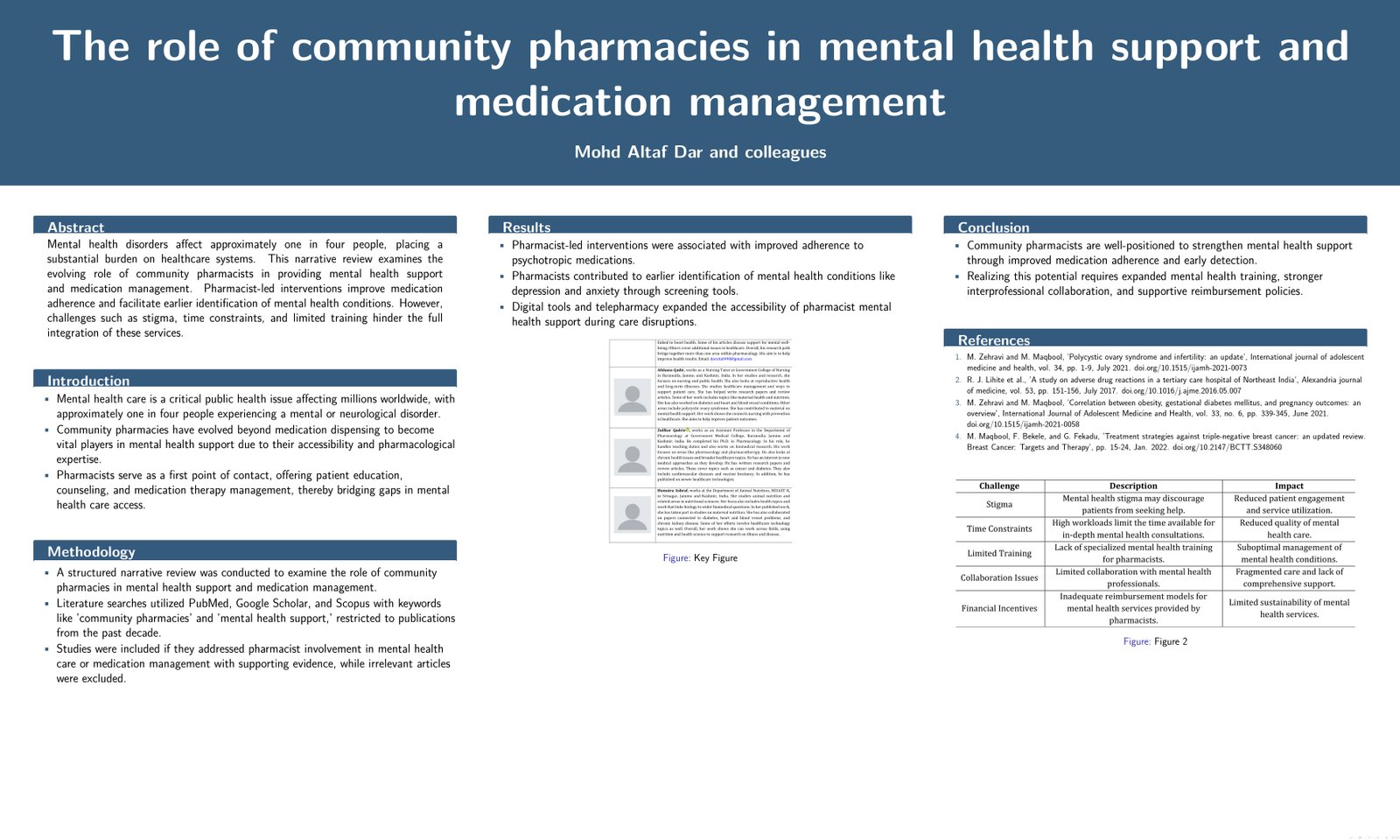
Background: Mental health disorders affect an estimated one in four people over their lifetime, placing a substantial burden on healthcare systems worldwide. traditionally focused on medication dispensing, have increasingly emerged as accessible frontline contributors to mental health care. Objective: To examine the evolving role of community pharmacists in mental health support and medication management, including medication therapy management, patient counseling, screening, and referral pathways, and to identify barriers limiting fuller integration of mental health services into pharmacy practice. Methods: A structured narrative review was conducted using PubMed, Google Scholar, and Scopus. Searches used the terms "community pharmacies," "mental health support," "medication management," "pharmacist interventions," and "psychotropic medication," restricted to publications from the past decade. Studies were included if they addressed pharmacist involvement in mental health care or medication management with supporting qualitative or quantitative evidence; articles lacking direct relevance or empirical grounding were excluded. Results: Pharmacist-led interventions including adherence counseling, side-effect monitoring, and medication reconciliation were associated with improved adherence to psychotropic medications and earlier identification of conditions such as depression and anxiety through both informal patient interaction and structured screening tools. Digital tools and telepharmacy further extended this reach during care disruptions such as the COVID-19 pandemic. However, integration remains constrained by mental health stigma, time pressure within pharmacy workflows, limited specialized training, weak collaboration with mental health specialists, and inadequate reimbursement models. Conclusion: Community pharmacists are well positioned to strengthen mental health support through improved medication adherence and early detection, but realizing this potential requires expanded mental health training, stronger interprofessional collaboration, and supportive reimbursement policy.
Published
How to Cite
Issue
Section
Copyright (c) 2024 Mohd Altaf Dar, Afshana Qadir, Zulfkar Qadrie, Humaira Ashraf

This work is licensed under a Creative Commons Attribution 4.0 International License.