DeepBESS: an explainable deep learning framework for battery energy storage system state-of-health prediction and adaptive charging control in renewable energy microgrids
Keywords:
State-Of-Health Prediction, Xgboost-ARIMA, SHAP Explainability, Renewable Energy Microgrid, Adaptive, Charging Control, Embedded Systems.Abstract
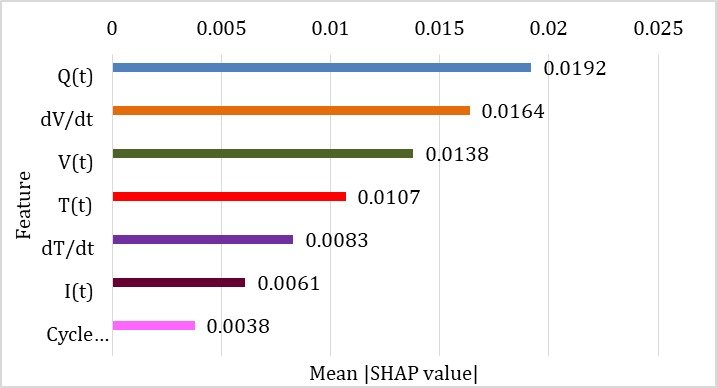
Renewable energy microgrids can't function without Lithium-ion Battery Energy Storage Systems (BESS), which act as a buffer between load demand on the grid and intermittent renewable energy resources like photovoltaic (PV) systems. The core issues in maximizing the battery life, operational safety and economic viability in these systems include accurate prediction of State-of-Health (SoH) and adaptive charging control. This paper introduces a novel explainable deep learning framework (DeepBESS), which not only applies a Temporal Convolutional Network-Bidirectional Long Short-Term Memory (TCN-BiLSTM) hybrid network to effectively predict SoH status at multiple time horizons but also uses an XGBoost-ARIMA joint optimization module to generate an adaptive charging schedule. A Shapley Additive Explanations (SHAP) interpretability layer is integrated to illustrate SoH predictions at feature-level, and without the need for electrochemical expertise for engineering insights. It is tested on two public datasets -- the NASA Battery Dataset, and the Oxford Battery Degradation Dataset -- with a strict split on the cell level for training, validation and test sets of 70/15/15 per cent respectively. The SoH prediction Root Mean Square Error (RMSE) and the Mean Absolute Error (MAE) of DeepBESS are 0.87% and 0.62% respectively, which is a 31.4% improvement in RMSE compared to a Vanilla Long Short-Term Memory (LSTM) baseline and 12.1% compared to the XGBoost-ARIMA standalone model. The adaptive charging controller is tested by a STM32F429ZI based embedded BESS testbed and extends simulated battery cycle life by 18.3% compared to a conventional Constant Current-Constant Voltage (CC-CV) charge controller, with an embedded real-time estimation of the battery's Health of Charge (SoH) being reached with a latency of 47 milliseconds. The dominant degradation indicators that can be identified using SHAP analysis are the voltage rate dV/dt and discharged capacity Q(t). The proposed solution is highly deployable, interpretable and accurate, and provides a full battery health management solution for next generation renewable energy microgrids. The results show that the temporal deep learning combined with explainability and adaptive control results in significant improvements in the predictive performance as well as the battery operational time.
Published
How to Cite
Issue
Section
Copyright (c) 2025 Dr. Raynukaazhakarsamy

This work is licensed under a Creative Commons Attribution 4.0 International License.