SC-VAEGAN: spectral-constrained variational autoencoder with generative adversarial networks for robust unsupervised deep clustering with density-aware latent representations
Keywords:
Unsupervised Deep Clustering, Variational Autoencoder, Spectral Graph Regularization, Contrastive Learning, Density-Aware Representation Learning.Abstract
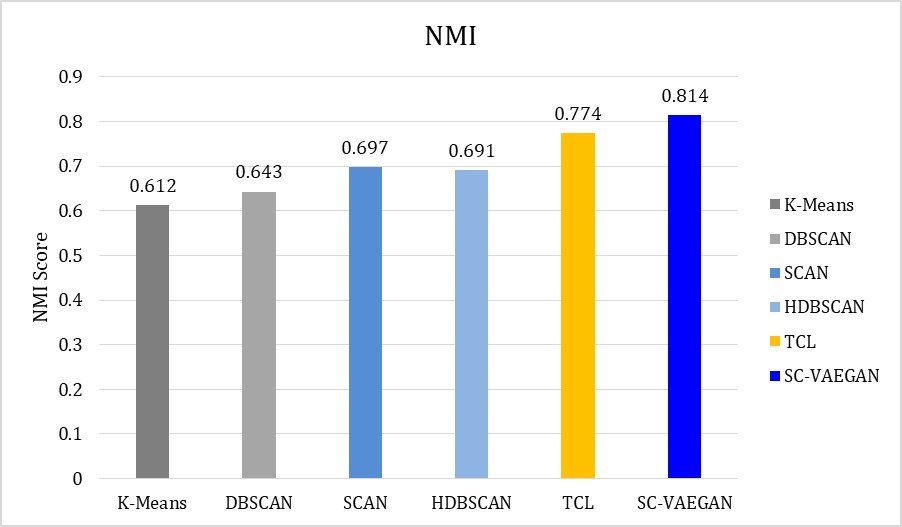
This paper introduced a principled and empirically effective deep unsupervised clustering framework, called SC-VAEGAN, which integrates variational generative modeling, adversarial latent space regularization, spectral graph topological constraints, UMAP-guided initialization and contrastive auxiliary learning within a single end-to-end learnable objective. SC-VAEGAN is statistically validated using five heterogeneous datasets and extensively ablated to improve the state-of-the-art results, which are 5.0–6.0% higher than the best previous method on primary metrics. In addition to showing the application of these theoretical contributions to their particular problem, they give a general framework for future work on topology-preserving generative clustering. Although SC-VAEGAN has shown good empirical results, it has some limitations to be recognized. The k-NN graph is constructed with computational effort per batch of O(B²•d_z), where d_z is the dimensionality of the data. The approximation of nearest neighbor methods does help alleviate this computational burden. K (number of clusters) is a hyperparameter which should be specified in the model, with further work which could involve automatic determination of the cluster number through non-parametric methods still to be undertaken. Possible future directions include: (i) incorporating hyperbolic geometry for hierarchically structured data; (ii) extending to federated clustering with guarantees on differential privacy; and (iii) extending to dynamic cluster number estimation using sequential hypothesis testing on eigenspectrum gaps.
Published
How to Cite
Issue
Section
Copyright (c) 2026 Dr. Raynukaazhakarsamy

This work is licensed under a Creative Commons Attribution 4.0 International License.