
Evaluating model performance and prediction accuracy of fuzzy logic and bayesian networks with business expert inputs
Keywords:
Fuzzy Logic, Bayesian Networks, Expert Systems, Model Evaluation, Decision SupportAbstract
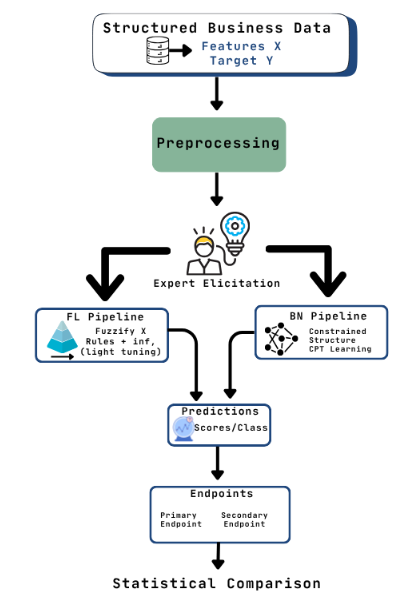
This paper evaluates and compares two expert-in-the-loop decision-support paradigms Fuzzy Logic (FL) and Bayesian Networks (BN) for barangay-level business risk assessment using the BizLocator Analytics dataset of Cauayan City, Philippines. Local governments need transparent, data-driven tools that can operate under uncertainty, sparse data, and evolving economic conditions. FL and BN are both well-established approaches for modeling uncertainty, yet they are rarely examined side by side on the same dataset with the same expert knowledge. To address this gap, the study develops parallel FL and BN models grounded in identical features and informed by the same pool of business and experts. The FL model uses expert-defined triangular and trapezoidal membership functions, together with a compact set of IF–THEN rules that encode linguistic concepts such as “Low Compliance,” “Vulnerable Barangay,” and “High Risk.” The BN model encodes expert-elicited causal relationships as a directed acyclic graph and learns conditional probability tables from data under Dirichlet priors. A unified preprocessing pipeline is applied, and nested stratified cross-validation is used to avoid optimistic bias and to support paired statistical tests. Both models are evaluated on discrimination (Accuracy, F1-score, ROC–AUC, PR–AUC) and probabilistic quality (Brier score, Expected Calibration Error, reliability diagrams). Results show that BN achieves slightly higher discrimination and notably better calibration, while FL offers superior case-level interpretability through rule and membership visualizations. Expert validation confirms that most BN edges are causally plausible and FL rules covers the majority of decisions. The findings suggest that a hybrid deployment using BN as the calibrated scoring backbone and FL as an explanation and policy-communication layer can provide accurate, transparent, and actionable decision support for local business risk governance and long-term planning. Overall, the study demonstrates how expert-guided artificial intelligence can strengthen evidence-based regulation while preserving human oversight and accountability in practice across diverse barangay.
References
ZadehL. A.Fuzzy SetsInformation and Control196510.1016/S0019-9958(65)90241-X
CiochM.KuliszM.The use of fuzzy logic in the decision-making process regarding the use of outsourcing in companiesJ. Mod. Sci.5456682202310.13166/jms/176173
MonferdiniL.CasellaG.BottaniE.Development of a fuzzy logic-based tool for evaluating KPIs in a lean, Agile, resilient, and green (LARG) supply chainAppl. Sci. (Basel)15148010202510.3390/app15148010
JiaY.WangZ.Application of artificial intelligence based on the fuzzy control algorithm in enterprise innovationHeliyon106e28116202410.1016/j.heliyon.2024.e28116
YangS.DemichelaM.GengJ.WangL.LingZ.A data-driven Bayesian network of management and organizational factors for human reliability analysis in the process industryHeliyon1015e35048202410.1016/j.heliyon.2024.e35048
MohammadI. B.AhmadM. M.Bayesian model prediction for breast cancer survival: A retrospective analysisEur. J. Breast Health213255264202510.4274/ejbh.galenos.2025.2025-2-14
SurapuntT.WangS.Ensemble modeling with a Bayesian maximal information coefficient-based model of Bayesian predictions on uncertainty dataInformation (Basel)154228202410.3390/info15040228
XuJ.SuiY.YuT.DingR.DaiT.ZhengM.A new fuzzy Bayesian inference approach for risk assessmentsSymmetry (Basel)167786202410.3390/sym16070786
JiaY.WangZ.Application of artificial intelligence based on the fuzzy control algorithm in enterprise innovationHeliyon106e28116202410.1016/j.heliyon.2024.e28116
YiğitF.A novel type-2 hexagonal fuzzy logic approach for predictive safety stock management for a distribution businessSci. Rep.13119835202310.1038/s41598-023-46649-0
SkrzekK.MazgajczykE.DybałaB.Application of fuzzy logic-based expert advisory systems in optimizing the decision-making process for material selection in additive manufacturingMaterials (Basel)182324202510.3390/ma18020324
EtiS.YükselS.DinçerH.PamucarD.DeveciM.OlaruG. O.A machine learning and fuzzy logic model for optimizing digital transformation in renewable energy: Insights into industrial information integrationJ. Ind. Inf. Integr.42100734202410.1016/j.jii.2024.100734
AttarS. F.MohammadiM.PasandidehS. H. R.A Bayesian network approach to production decisions by incorporating complex causal factorsJ. Manag. Sci. Eng.102262278202510.1016/j.jmse.2025.03.002
MorićZ.DakićV.UroševS.An AI-based decision support system utilizing Bayesian networks for judicial decision-makingSystems132131202510.3390/systems13020131
KayaR.SalhiS.SpieglerV.A novel integration of MCDM methods and Bayesian networks: the case of incomplete expert knowledgeAnn. Oper. Res.3201205234202310.1007/s10479-022-04996-7
MahboubH.SadokH.ChehriA.SaadaneR.Measuring the digital transformation: A key performance indicators literature reviewProcedia Comput. Sci.22545704579202310.1016/j.procs.2023.10.455
AydınM.Risk assessment of solid bulk cargo liquefaction consequences in maritime transportation under a fuzzy Bayesian network approachJ. Transp. Logist.813647202310.26650/JTL.2023.1243766
KlirG. J.YuanB.Fuzzy sets and fuzzy logic: theory and applicationsPrentice Hall of India2003
RossT. J.Fuzzy logic with engineering applicationsJohn Wiley201010.1002/9781119994374
TanW. W.ChuaT. W.Uncertain Rule-Based Fuzzy Logic Systems: Introduction and New Directions (Mendel, J.M.; 2001) [book review]IEEE Comput. Intell. Mag.217273200710.1109/MCI.2007.357196
Published
How to Cite
Issue
Section
Copyright (c) 2026 Jane B. Gelindon1

This work is licensed under a Creative Commons Attribution 4.0 International License.


