
Life skills for promoting mental well-being among Indian adolescents and youth
Keywords:
Adolescents, Digital Literacy, Holistic Development, Jeevan Kaushal Curriculum, Life Skills, Mental Wellbeing.Abstract
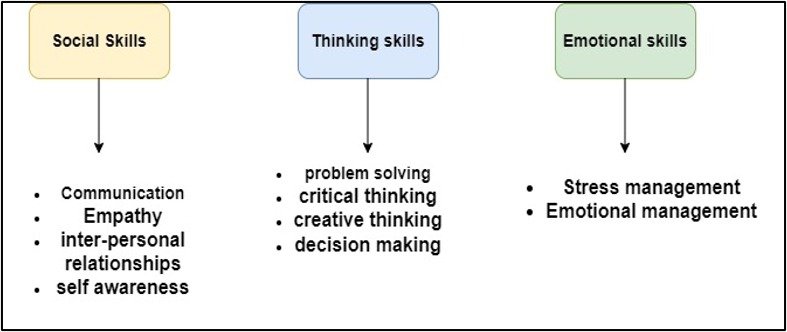
Background: Adolescents and youth undergo significant biological, socio-emotional, and psychological transitions that, combined with family, peer, and institutional pressures, heighten their vulnerability to stress and poor mental health outcomes, particularly in resource-limited settings such as India. Objective: To examine the role of life skills-based training, as articulated in key policy documents, in supporting the mental well-being of Indian adolescents and youth. Methods: A qualitative document analysis was conducted on three core policy documents: the World Health Organization's (WHO) Universal Health Coverage (UHC) for Mental Health initiative (2019–2023), the University Grants Commission's Jeevan Kaushal Curriculum (2.0) (2023), and India's National Education Policy (NEP) 2020. Results: The WHO framework identifies core life skills spanning cognitive, social, and emotional domains, including problem-solving, critical thinking, communication, self-awareness, empathy, and stress/emotion coping. The Jeevan Kaushal Curriculum (2.0) operationalizes comparable competencies through four courses communication skills, professional skills, leadership and management skills, and universal human values delivered through experiential methods such as role play, case studies, group discussion, and digital learning. These domains closely align with NEP 2020's emphasis on holistic, multidisciplinary education. Conclusion: The Jeevan Kaushal Curriculum (2.0) offers a practical, policy-aligned framework for cultivating life skills that may strengthen mental well-being among Indian adolescents and youth. Its consistency with WHO and NEP 2020 guidelines supports its integration into undergraduate curricula as a preventive, skill-based approach to mental health promotion, warranting further empirical evaluation of implementation.
References
M. N. Vranda and C. Rao, 'Life Skills Education for Young Adolescents -Indian Experience', Journal of Indian Academy of Applied Psychology, 37 Special Issue, pp. 9-15, 2007.
S. Rajeswari and J. O. J. G. Eljo, 'Adolescent school students and life skills-A descriptive study', Journal of Namibian Studies, vol. 35, pp. 2999-3022, 2023.
V. Patel, 'Acting Early: The Key to Preventing Mental Health Problems', Journal of the Royal Society of Medicine, vol. 111, no. 5, pp. 153-157, 2018. doi.org/10.1177/0141076818764995
L. R. Koenig et al., 'Unequal Gender Norms Are Related to Symptoms of Depression among Young Adolescents: A Cross-Sectional, Cross-Cultural Study', Journal of Adolescent Health, vol. 69, no. 1, pp. S47-S55, 2021. doi.org/10.1016/j.jadohealth.2021.01.023
Unicef (n.d.). Comprehensive Life Skills Framework. Delhi: Unicef House.
World Mental Health Report: Transforming Mental Health for All. Geneva: World Health Organization, 2022.
M. N. Vranda and C. Rao, 'Life Skills Education', in Handbook of Psychiatric Social Work, K. Sekar, R. Parthasarthy, D. Muralidhar, and C. Rao, Eds Bangalore: NIMHANS Publication, 2006, pp. 52-58.
R. Neslon-Jones, Life Skills: A handbook. Trowbridge, Wilts: Dotesios Ltd, 1992.
B. A. Hamburg, Life skills training: Preventive interventions for young adolescents. Washington D.C.: Carnegie Council on Adolescent Development, 1990.
Y. Wei, C. Gilham, and S. Kutcher, 'Evaluation of Know Before You Go on mental health literacy and life skills to prepare for life after high school', Canadian Journal of Behavioural Science, vol. 56, no. 2, pp. 133-143, 2024. doi.org/10.1037/cbs0000341
M. Shah, 'Improving mental health of adolescent girls in low- and middle-income countries-Causal Evidence from Life Skills Programming', The Journal of Human Resources, pp. 317-364, 2024. doi.org/10.3368/jhr.1222-12707R2
'Youth focused life skills training and counselling services program-An inter-sectoral initiative in India: Program development and preliminary analysis of factors affecting life skills', PLoS One, vol. 18, no. 8, 2023. doi.org/10.1371/journal.pone.0284771
'Selflife: A Life Skills Development Tool to Prevent Sexual Violence among Healthcare Students', International Journal of Environmental Research and Public Health, vol. 20, 2023. doi.org/10.3390/ijerph20065198
J. M. John and R. Sharma, 'Effectiveness of life skills training to enhance mental health status and wellbeing of children and adolescents', Pediatr Med, 2020. doi.org/10.21037/pm.2020.AB010
I. Nagpal and S. Guha, 'Life Skills Training and Adolescents with Disabilities: A Review Study', EDUCATION TIMES, vol. 14, no. 1, pp. 120-125, 2018.
J. Corbin and A. Strauss, Basics of qualitative research: Techniques and procedures for developing grounded theory. Thousand Oaks, CA: Sage, 2008. doi.org/10.4135/9781452230153
Rapley, T. (2007). Doing conversation, discourse and document analysis. London: Sage. doi.org/10.4135/9781849208901
G. A. Bowen, 'Document Analysis as a Qualitative Research Method', Qualitative Research Journal, vol. 9, no. 2, pp. 27-40, 2009. doi.org/10.3316/QRJ0902027
'The WHO Special Initiative for Mental Health (2019-2023): Universal Health Coverage for Mental Health', Mental Health Atlas, 2018.
Curriculum and guidelines for Life Skills (Jeevan Kaushal 2.0). New Delhi: University Grants Commission, 2023.
Ministry of Human Resource Development. (2020). National Education Policy.
K. A. A. Gamage, D. M. S. C. P. Dehideniya, and S. Y. Ekanayake, 'The Role of Personal Values in Learning Approaches and Student Achievements', Behavioural Sciences, 2021. doi.org/10.3390/bs11070102
K. Thakar and K. N. Modi, 'Importance of Life Skills for Adolescents', International Journal for Research in Education (IJRE), vol. 5, no. 2, pp. 19-22, 2016.
Life Skills Education for Children and Adolescents in Schools. Geneva: World Health Organization, 1997.
Published
How to Cite
Issue
Section
Copyright (c) 2024 Dr. Sampurna Guha

This work is licensed under a Creative Commons Attribution 4.0 International License.


