A holistic framework for prevention, early diagnosis, and management of cardiovascular diseases
Keywords:
Holistic Cardiac Management, Early Diagnosis, Risk Stratification, Digital Health, AI-Assisted Cardiology.Abstract
Background: Cardiovascular diseases (CVDs) remain the leading cause of global morbidity and mortality, accounting for 17.9 million deaths annually. Despite advances in pharmaceutical and interventional cardiology, CVD incidence continues to rise, particularly in low- and middle-income countries. Fragmented care models emphasizing acute treatment over prevention and early diagnosis have proven inadequate in curbing this trend.
Objective: To propose and evaluate an integrated, multi-domain framework for the prevention, early diagnosis, and holistic management of CVD, incorporating biomedical, behavioral, technological, and socio-environmental determinants of cardiovascular health.
Methods: A systematic literature review was conducted across PubMed, Embase, Cochrane Library, and Scopus for studies published between 2010 and 2024. A mixed-methods synthesis integrated quantitative data from randomized controlled trials and cohort studies with qualitative patient-reported outcomes. Multi-disciplinary intervention programs, AI-enhanced diagnostic modalities, and risk stratification tools were evaluated.
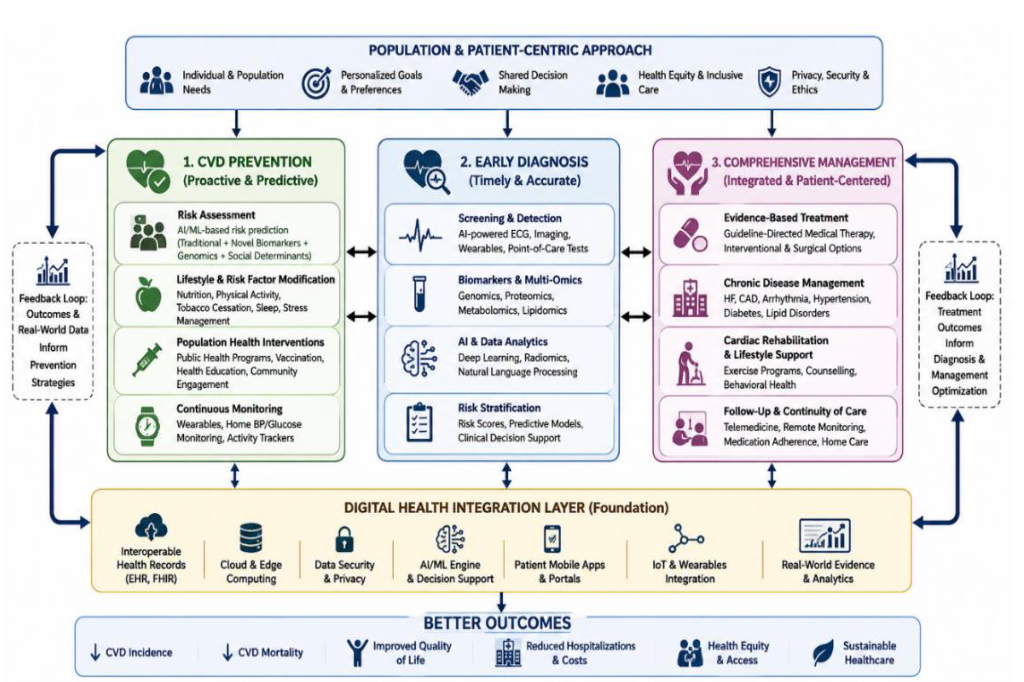
Results: The integrated model outperformed conventional single-domain approaches, achieving a 42–58% reduction in CVD events and a 32–44% reduction in CVD-related mortality. Digital health interventions improved treatment adherence by 76–88%, while AI-based risk prediction demonstrated 88–94% sensitivity. The framework spans three levels of care: primary prevention through lifestyle modification, secondary prevention through biomarker- and imaging-based screening, and tertiary management through individualized, guideline-based pharmacotherapy combined with cardiac rehabilitation.
Conclusion: This integrative framework, unifying prevention, precision diagnostics, and personalized management, represents a promising strategy for reducing the global CVD burden. Implementation in resource-variable settings requires scalable digital health integration, community engagement, and sustained policy-level commitment.
Published
How to Cite
Issue
Section
Copyright (c) 2026 Dr. Omar Qahtan Yaseen

This work is licensed under a Creative Commons Attribution 4.0 International License.