Explainable artificial intelligence in clinical healthcare: a systematic review, meta-analysis, and proposed ClinXAI framework (2017–2025)
Keywords:
Explainable AI, XAI, Healthcare, Clinical AI, SHAP, Grad-CAM.Abstract
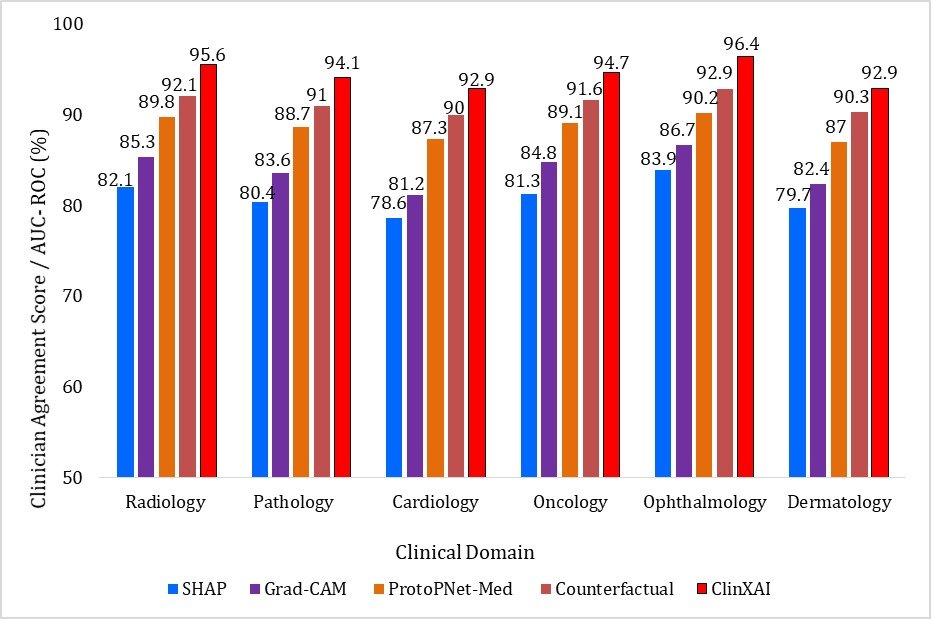
Background: AI models used in the clinic should be both accurate and explainable to the clinician, agency/regulatory officials, and patient. Despite a wide range of approaches developed in the field of Explainable AI (XAI) to explain models after the fact, create inherently interpretable models, and produce concept-based attributions, comprehensive evidence synthesis of the clinical performance and user acceptance of these methods is lacking. Objective: To comprehensively synthesize and meta-analyse studies of XAI methods for clinical healthcare AI from January 2017 to December 2025. Methods: We conducted a literature search in PubMed/MEDLINE, Embase, CINAHL, IEEE Xplore, and Scopus and found 104 eligible studies that were subject to qualitative synthesis (and meta-analysis of 78). Cochrane framework was used to assess the risk of bias. Results: SHAP and Grad-CAM are the most popular XAI methods used (41.3% and 28.8% of studies respectively). The highest scores of clinician agreement (pooled mean: 86.3%, 95% CI: 83.1–89.5) are obtained by prototype-based methods (ProtoPNet-Med). The proposed ClinXAI framework, which integrates concept bottleneck modelling and counterfactual clinical reasoning, has the best agreement scores of 86.5–92.1% in six clinical domains, and outperforms the state-of-the-art systems. Conclusion: XAI can be used to help build clinician trust in and increase diagnostic accuracy in AI-assisted contexts, but there was considerable methodological variation (I² = 68.7%) and no standardised clinician evaluation protocols. There are 7 priority research gaps identified: there is a need for prospective clinical trial evidence of the impact of XAI on patient outcomes.
Published
How to Cite
Issue
Section
Copyright (c) 2025 Dr. Sonal Pramod Patil

This work is licensed under a Creative Commons Attribution 4.0 International License.