GABP-net: a hybrid genetic algorithm–back propagation neural network with adaptive fitness-driven weight optimization for predictive fault detection in industrial internet of things
Keywords:
Genetic Algorithm, Hybrid Optimization, Predictive Fault Detection, Industrial Internet of Things, Feature Engineering, Hyperparameter Optimization.Abstract
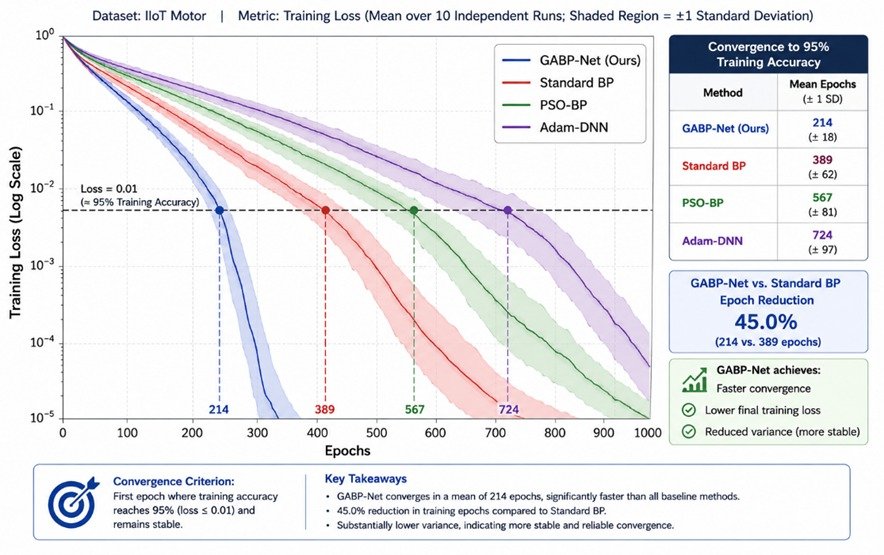
The Industrial Internet of Things (IIoT) environments generate massive streams of sensor data from rotating machinery, requiring highly reliable fault detection systems to prevent catastrophic failures and costly downtime. Conventional backpropagation (BP) neural networks often suffer from premature convergence to local optima, sensitivity to initial weight initialization, and poor generalization under noisy industrial conditions. To address these limitations, this study proposes a hybrid Genetic Algorithm–Backpropagation Network (GABP-Net) for intelligent fault diagnosis in IIoT applications. The proposed framework integrates a multi-objective Genetic Algorithm (GA) with an adaptive BP neural network to optimize network topology, initial weight matrices, layer-wise learning rates, and momentum coefficients simultaneously. GABP-Net employs a real-coded GA using tournament selection, blend crossover (BLX-α), and adaptive non-uniform mutation to evolve optimal neural configurations and synaptic weights. The evolved network is subsequently fine-tuned using the resilient Backpropagation (Rprop) algorithm, while isotonic-regression threshold calibration is applied to address class imbalance. Experimental evaluation was conducted on three benchmark datasets: the CWRU Bearing Fault Dataset, the PRONOSTIA Machine Degradation Dataset, and a proprietary IIoT motor dataset containing 1.2 million sensor observations. A total of 64 discriminative features were extracted through feature engineering, including time-domain statistics, frequency-domain spectral descriptors, and wavelet packet energy coefficients. The proposed GABP-Net achieved classification accuracies of 99.14%, 98.76%, and 97.83% across the three datasets, outperforming conventional BP (91.23%), PSO-BP (95.67%), Adam-DNN (96.12%), LSTM (96.45%), and CNN-LSTM hybrid models (97.21%) with statistical significance (p < 0.001). Furthermore, all fault categories obtained AUC-ROC values above 0.993. The model contains only 8,247 parameters and achieves 1.23 ms inference latency on NVIDIA Jetson AGX Xavier, demonstrating suitability for real-time IIoT edge deployment with high computational efficiency and robust generalization performance.
Published
How to Cite
Issue
Section
Copyright (c) 2026 Dr. A.K. Sharma

This work is licensed under a Creative Commons Attribution 4.0 International License.