Supervised machine learning models for cancer prognosis and treatment response prediction: A systematic review of algorithm performance, feature importance, and clinical deployment
Keywords:
Supervised Machine Learning, Cancer Prognosis, Treatment Response, Random Forest, XGBoost, SHAP.Abstract
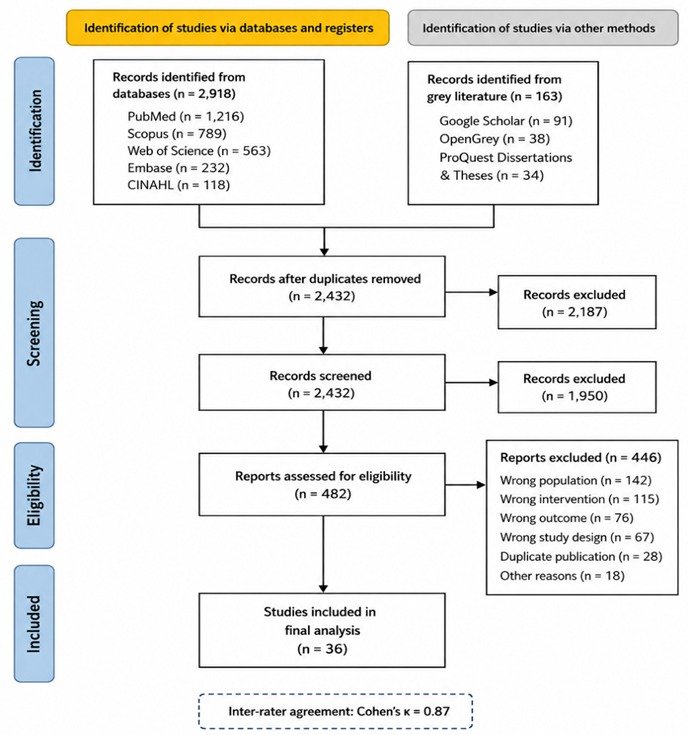
Recently, Supervised machine learning (SML) has become an exciting paradigm in clinical oncology for building prediction models based on the available clinical, genomic, imaging and treatment data, to predict outcomes and responses to cancer treatment. Although numerous studies in SML have been published, there is no systematic evaluation of the performance of the algorithms, the extent of consistency across SML studies and algorithms, the quality of calibration, or the readiness for clinical implementation. This review aims to bridge this gap by summarising the findings of 36 studies in a variety of cancers.
Methods: We searched for the PubMed/MEDLINE, Embase, IEEE Xplore, Web of Science and the ACM Digital Library for publications between January 2018 and January 2025, according to the PRISMA 2020 guidelines and registered in PROSPERO (CRD42025412104). Cancer prognosis and/or prediction of treatment response studies that developed or had models validated by other groups were included. A five domain PROBAST-AI quality assessment was used.
Results: 36 studies with 34 different oncology datasets comprising of more than 3.1 million patient records were eligible. Random Forest was the most frequently deployed algorithm (n = 24, 67%), followed by XGBoost (n = 21, 58%) and SVM (n = 16, 44%). Median best-reported AUC was 0.908 (IQR: 0.887–0.927). In 33 out of 36 studies (92%), the SML models outperformed clinical staging and the average AUC gain was 0.108. Tumour stage and a number of key biomarkers turned out to be consistently important predictors. There were significant methodological gaps in reporting calibration in just 41% of studies.
Conclusions: Conventional oncological models are not as effective as SML models, and the SML models provide clinically meaningful performance improvements that are consistent. However, there are gaps in the prospective validation, reporting of features used for the result, as well as standardized representations of the features' importance. A checklist of 16 items (SML-ONCO-Report) is proposed to help overcome the reporting failures. The systematic results here reported are actionable to inform clinical trials for the use of SML in oncology.
Published
How to Cite
Issue
Section
Copyright (c) 2026 Hidayath Ali Baig Mohammed

This work is licensed under a Creative Commons Attribution 4.0 International License.