Intervention studies for mental health: a comprehensive exploration of historical evolution, theoretical foundations, and contemporary applications
Keywords:
Intervention, Training, Behaviour Modifications, Issues of Intervention, Psychology of Intervention.Abstract
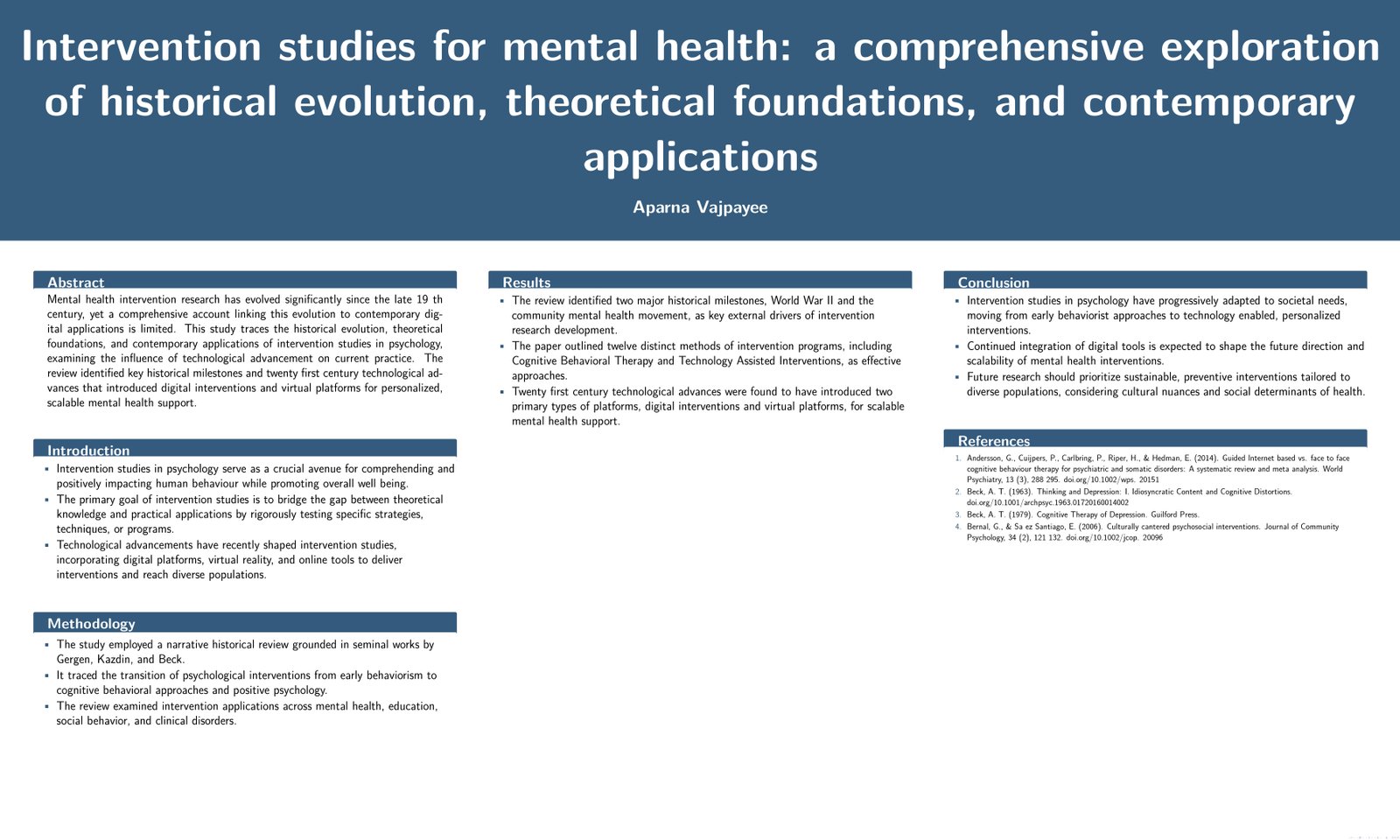
Background: Mental health intervention research has evolved substantially since the late 19th century, shaped by shifting theoretical paradigms and external historical influences, yet a comprehensive account linking this evolution to contemporary digital applications is limited. Objective: To trace the historical evolution, theoretical foundations, and contemporary applications of intervention studies in psychology, and to examine the influence of technological advancement on current practice. Methods: Narrative historical review grounded in seminal works (Gergen, Kazdin, Beck) tracing the transition from behaviorism to cognitive-behavioral approaches and positive psychology, and examining intervention applications across mental health, education, social behavior, and clinical disorders. Results: Key historical milestones, including World War II and the community mental health movement, were identified as major external drivers of intervention research development. Twenty-first century technological advances were found to have introduced digital interventions and virtual platforms capable of delivering personalized, scalable mental health support across diverse domains. Conclusion: Intervention studies in psychology have progressively adapted to societal needs, moving from early behaviorist approaches to technology-enabled, personalized interventions. Continued integration of digital tools is likely to shape the future direction and scalability of mental health interventions.
Published
How to Cite
Issue
Section
Copyright (c) 2023 Prof. Aparna Vajpayee

This work is licensed under a Creative Commons Attribution 4.0 International License.