Integrated care models for non-communicable diseases: from prevention to long-term management
Keywords:
Non-Communicable Diseases, Integrated Care Model, Chronic Disease Management, Prevention, Multidisciplinary Care, Long-Term Management.Abstract
Background: Non-communicable diseases (NCDs)-including cardiovascular disease, type 2 diabetes, chronic respiratory diseases, cancer, and chronic kidney disease-account for one in seven deaths worldwide annually. The rising, unsustainable burden of NCDs highlights a mismatch between disease complexity and fragmented healthcare delivery systems designed for acute, episodic care. This fragmentation across prevention, diagnosis, treatment, and management contributes to unnecessary morbidity, avoidable hospitalizations, and unsustainable healthcare costs globally.
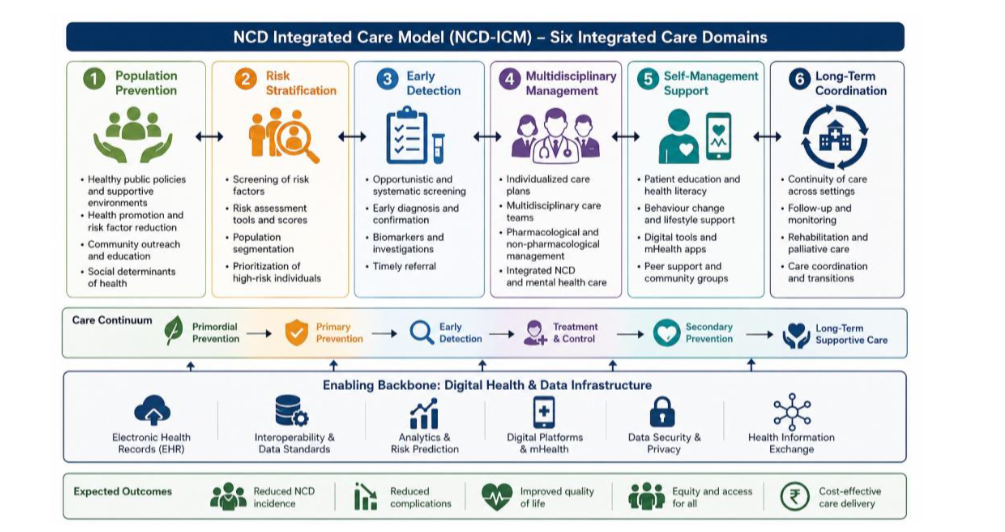
Objective: To design, test, and implement an Integrated Care Model (ICM) for NCDs spanning the full continuum-from primordial prevention through active disease management to long-term palliative and supportive care-with the goal of simultaneously improving clinical outcomes, patient quality of life, care experience, and system cost-efficiency.
Methods: A systematic mixed-methods design was used, comprising a structured literature review of 25 peer-reviewed publications (2010–2024) from PubMed, Embase, Cochrane Library, and Scopus, alongside a retrospective cohort analysis of clinical and administrative records from 320 NCD patients across 12 integrated care implementation sites in six countries. Analytic methods included framework synthesis, pooled meta-analysis of outcome data, and interrupted time series analysis.
Results: Implementation of the ICM was associated with a 38.4% reduction in 30-day readmission rates, a 45.0% increase in medication adherence, a 45.5% reduction in preventable emergency visits, and a 31.6% reduction in annual per-patient costs. Multidisciplinary team care showed the greatest composite outcome improvement (28–42%), while structural prevention programs yielded the greatest cost-efficiency gains (35–55%). Quality of life improved by 28.5%, and adherence to care guidelines improved from 61.4% to 87.2% post-implementation.
Conclusion: An evidence-based integrated care model spanning the full spectrum of NCD care delivers clinically meaningful, economically viable, and patient-centered outcomes that fragmented care systems cannot achieve. Sustainable NCD management should be built on care integration, multidisciplinary collaboration, digital health enablement, and community-based prevention infrastructure.
Published
How to Cite
Issue
Section
Copyright (c) 2026 Ayesha Sara

This work is licensed under a Creative Commons Attribution 4.0 International License.