Pharmacological management of obesity: a comprehensive narrative review of diagnostic classification, incretin-based and legacy drug therapy, and landmark trial evidence
Keywords:
Pharmacology, Obesity, Incretin, Cardiovascular Prevention, GLP-1 Receptor Agonist, Tirzepatide.Abstract
Background: Obesity is officially a chronic relapsing condition and is estimated to affect 890 million adults around the world in 2022. Incretin-based pharmacotherapy has revolutionized the magnitude of weight loss we can achieve in order to modify the disease; thus, pharmacotherapy is now one of the main disease-modifying treatment modalities.
Objective: This narrative review summarizes up-to-date diagnostic classification criteria, comparative pharmacology of the legacy and incretin-based anti-obesity drugs, and evidence from landmark randomized trials that has directed contemporary anti-obesity drug prescribing and management.
Methods: PubMed/MEDLINE, Cochrane Library and ClinicalTrials.gov were used to conduct a structured narrative search of phase 3 randomized, placebo or active-controlled trials of anti-obesity pharmacotherapy, and the most recent World Health Organization (WHO) guidance was identified between 1990 and 2025.
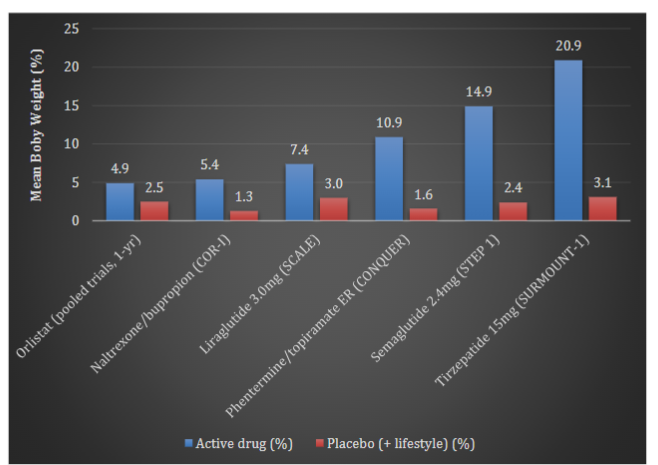
Results: Mean weight loss was 2–4 percentage points less with orlistat compared with placebo and 17–19 percentage points less with tirzepatide 15 mg compared with placebo, which is a 5-fold difference in efficacy across the 6 major drug classes. Cardiovascular outcome benefit was shown in the SELECT trial in 17,604 participants without diabetes, with an HR of 0.80 (95% CI 0.72–0.90). Comparative pharmacology, evidence from trials, safety monitoring, patient selection and an integrated treatment algorithm are introduced.
Conclusions: The age of drugs to promote weight loss of more than 15-20% of body weight has arrived and drugs that affect the incretins offer a new path to sustained weight loss. These therapies cannot be stopped once they are started, and are often used for prolonged periods of time. Access to evidence-based pharmacotherapy is a critical opportunity to better manage obesity and prevent costly cardiometabolic conditions.
Published
How to Cite
Issue
Section
Copyright (c) 2025 Dr. Mosrur Ahmed

This work is licensed under a Creative Commons Attribution 4.0 International License.